TL;DR:
- Third-party cookies are disappearing, causing measurement gaps and unreliable attribution in digital marketing.
- Building on first-party signals, consent-aware tagging, and server-side data collection offers a resilient, privacy-compliant measurement approach.
Third-party cookies are disappearing, and for digital marketing teams, that means the tracking infrastructure built over the last two decades is quietly breaking down. Remarketing lists shrink, attribution gaps widen, and conversion data becomes unreliable. The good news is that this disruption is predictable and manageable. This guide walks you through a practical, step-by-step approach to auditing your current setup, rebuilding on first-party signals, reconfiguring your tags, and sustaining accurate measurement in a privacy-first environment.
Table of Contents
- Assessing and preparing for a cookieless world
- Shifting to first-party data and user consent
- Redesigning tagging and measurement for consent and cookieless signals
- Attribution and analytics without cookies: Modeling, session data, and server-side solutions
- Verification and ongoing adaptation: Monitoring, compliance, and continuous improvement
- Why a cookieless approach is your best marketing opportunity
- Get analytics you can trust: Faster adaptation for your team
- Frequently asked questions
Key Takeaways
| Point | Details |
|---|---|
| First-party data focus | Shifting to first-party, consented tracking is the foundation for survival in a cookieless future. |
| Consent-aware tagging | Modern tag managers and analytics tools must adapt in real-time to user privacy choices. |
| Modeling replaces user IDs | Attribution and analytics now rely on aggregated, contextual data and statistical models. |
| Continuous verification | Ongoing audits and compliance monitoring are mandatory as privacy standards evolve. |
| Opportunity for better marketing | A cookieless approach opens the door to more resilient, user-centric marketing strategies. |
Assessing and preparing for a cookieless world
The first move is not to panic and rebuild everything at once. It’s to understand exactly what you stand to lose. Most organizations have dozens of tags and pixels running across their properties, and a significant portion of them depend on third-party cookies for user identification, cross-site tracking, or remarketing. Before you can fix anything, you need a clear map.
Start by auditing every data collection method across your web properties and apps. This means cataloging all tags, pixels, and SDKs and classifying each one by how heavily it depends on third-party cookies. Use cookie scanner tools to automate discovery, and follow up with cookie audit tools to get a structured view of what’s firing, what it’s collecting, and what breaks without persistent identifiers.
Here’s what to include in your audit:
- Analytics tags (session tracking, pageview data, funnel events)
- Conversion pixels (ad platform pixels that rely on browser-stored identifiers)
- Remarketing tags (audience-building tools that depend on cross-site user profiles)
- Attribution scripts (multi-touch models that stitch sessions using cookie chains)
- A/B testing tools (experiment assignment stored in third-party cookies)
Once you have that list, classify each tool in a comparison table:
| Tag / Tool | Cookie dependency | Risk level | Cookieless alternative |
|---|---|---|---|
| Google Analytics 4 | First-party (session) | Low | Already partially cookieless |
| Meta Pixel | Third-party | High | Conversions API (server-side) |
| Google Ads remarketing | Third-party | High | Consent Mode + first-party lists |
| A/B testing platform | First or third-party | Medium | First-party session assignment |
| CRM tracking scripts | First-party | Low | Minimal changes needed |
As cookieless strategy guidance makes clear, you should build measurement on first-party, consented signals from owned channels like your website, app, CRM, email, and loyalty programs rather than third-party cookie-based user identifiers. That’s your north star for this audit. Everything that doesn’t align with that principle needs a replacement plan.
For server-side tracking methods, assess whether your infrastructure can support moving data collection off the browser entirely. Server-side setups reduce cookie reliance dramatically and are more resilient to browser-level restrictions.
Pro Tip: Start your audit with your highest-traffic and highest-revenue user journeys. A broken checkout pixel or a failed remarketing tag on your best-performing landing page will cost you far more than a broken event on a low-traffic blog post.
Shifting to first-party data and user consent
Once you’ve identified areas at risk, it’s time to build on the most reliable data source you have: your own first-party signals.
First-party data is information users share directly with you through forms, purchases, account registrations, email subscriptions, and loyalty programs. Unlike third-party cookies, this data doesn’t disappear when a browser update rolls out. It’s durable, privacy-compliant, and actually more accurate because it reflects real user intent rather than probabilistic inference.
“First-party, consented data is now the foundation for effective marketing measurement.”
Here’s a practical migration path:
- Map your first-party data sources. List every touchpoint where users voluntarily share data: contact forms, checkout flows, newsletter sign-ups, account logins, and loyalty enrollments.
- Audit your consent infrastructure. Review your consent banners for legal compliance. Are you capturing granular consent preferences? Are those preferences being passed to your tag management system? Check your cookie banner compliance setup carefully.
- Integrate your CRM with your analytics stack. When a user logs in or submits a form, that event should enrich your analytics data layer with a hashed, privacy-safe identifier. This lets you track behavior across sessions without relying on browser cookies.
- Implement email-based identity resolution. Hashed email addresses (SHA-256) passed through your data layer or server-side events are accepted by major ad platforms for conversion matching. This is one of the most effective replacements for third-party cookie-based audience building.
- Enrich loyalty and subscription programs. Users who join loyalty programs or subscribe to communications give you a direct, consented relationship. That data is yours to use for personalization and measurement.
The eliminating tracking cookies transition doesn’t have to mean losing insight. It means earning insight through better user relationships. And as cookieless strategy research confirms, owned channels are now the primary vehicle for sustainable measurement.
Pro Tip: Offer genuine incentives for users to share their data. A loyalty program discount, early access to content, or a personalized experience is a fair exchange that drives high-quality, consented data at scale.

Redesigning tagging and measurement for consent and cookieless signals
With first-party strategies in place, you need to ensure every tag and analytics system respects user choices and privacy laws at the technical level.
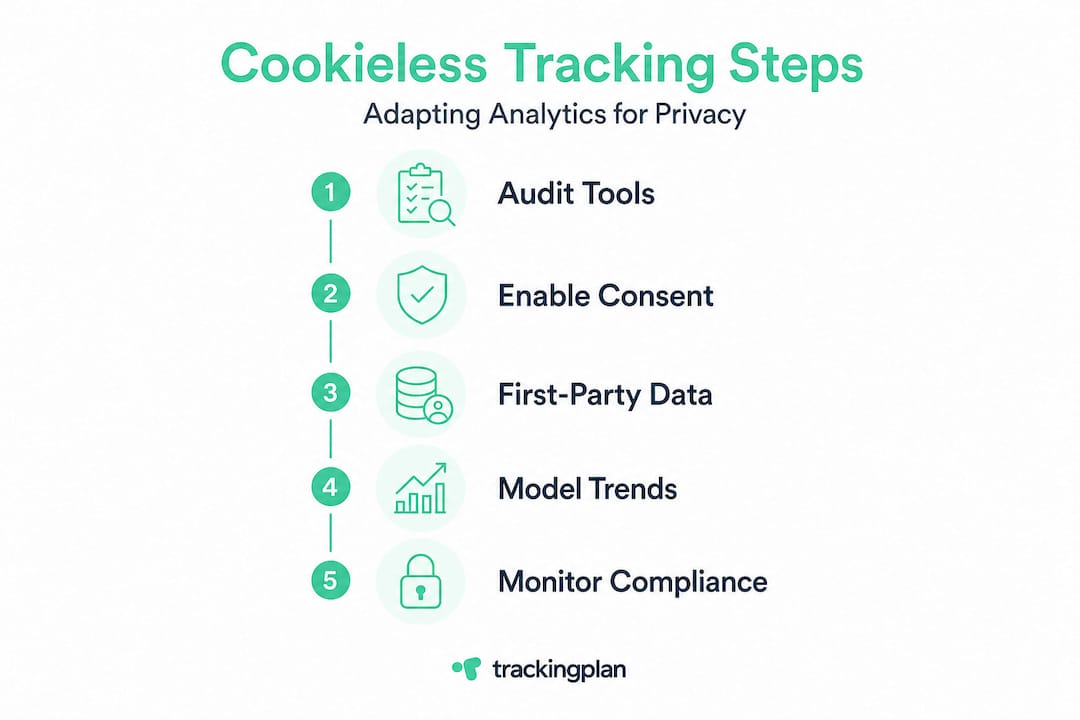
Consent Mode is the mechanism that allows your tags to adapt their behavior based on whether a user has granted or denied consent. When consent is denied, consent-mode mechanisms send cookieless signals and improve conversion measurement via modeling rather than losing all data. That’s a significant shift from the old approach of simply blocking tags entirely when consent is denied.
Here’s how the data capture changes across consent states:
| Tag type | Consent granted | Consent denied |
|---|---|---|
| Analytics (GA4) | Full session + user data | Aggregated, modeled data |
| Google Ads conversion | Full conversion event | Modeled conversion signal |
| Meta Pixel | Full event + user match | No pixel fire (use CAPI) |
| Remarketing | Audience building active | No audience building |
| Heatmaps / session recording | Full recording | Blocked or anonymized |
To implement consent-aware tagging correctly:
- Configure your consent management platform (CMP) to pass consent signals to your tag manager using the standard consent API format.
- Enable Consent Mode v2 in Google Tag Manager. This ensures Google tags adapt automatically based on user preferences, and it’s now required for advertisers running campaigns in the European Economic Area.
- Set up data layer events that fire regardless of consent state, but carry only non-identifying contextual data (page type, product category, funnel stage) when consent is denied.
- Implement server-side event forwarding for ad platforms. For Meta, this means the Conversions API. For Google, this means server-side Google Tag. These approaches reduce browser-level cookie dependency entirely.
- Verify tag behavior in both states. Use your browser’s developer tools and tag auditing software to confirm that tags fire correctly with consent granted and correctly suppress or switch to cookieless signals when consent is denied.
For a detailed walkthrough on preventing tags from firing before consent, the sequencing of your consent layer and tag triggers matters enormously. A misconfigured tag that fires before the consent check resolves can create serious legal exposure.
Also, for Google Ads measurement, upgrading to Consent Mode and ensuring the Google tag is correctly configured to respect consent while preserving conversion accuracy is now a baseline requirement, not an optional enhancement.
Pro Tip: Test your tag behavior regularly in both consent-granted and consent-denied states across different browsers and devices. A tag that works correctly in Chrome may behave differently in Firefox or Safari due to varying cookie and storage policies.
For a practical checklist on fixing cookie banner issues that affect tracking accuracy, start with your banner’s interaction with your tag manager consent triggers.
Attribution and analytics without cookies: Modeling, session data, and server-side solutions
Modern tagging and consent tools work best when paired with new approaches to attribution. The old model of stitching a user’s journey across sessions using a persistent cookie ID is gone. What replaces it is a combination of session-scoped data, contextual signals, and statistical modeling.
The key insight from cookieless attribution research is that you need to re-architect attribution to work without persistent browser identifiers by using session-scoped and contextual data plus modeling, rather than pretending the old cookie chain still exists. That’s a mindset shift as much as a technical one.
Here are the primary modeling strategies for cookieless attribution:
- Probabilistic matching: Use device type, browser, OS, screen resolution, and time-of-day signals to probabilistically match sessions without storing identifiers.
- Data-layer enrichment: Pass campaign parameters (UTM values), referrer data, and session context into every event so that each interaction carries its own attribution context.
- Aggregated conversion modeling: Platforms like Google Ads use machine learning to model conversions that can’t be directly observed due to consent gaps, filling in the picture without individual user tracking.
- Media mix modeling (MMM): Analyze the statistical relationship between ad spend across channels and aggregate outcomes. This approach doesn’t require user-level data at all.
- Incrementality testing: Run controlled experiments to measure the true causal impact of campaigns, bypassing the need for cross-session user tracking entirely.
Server-side tracking plays a critical supporting role here. By moving event collection to your server, you eliminate browser-based restrictions entirely for the data you’re permitted to collect. Your server-side analytics setup can log events with session context, pass consented identifiers to ad platforms, and maintain data quality even as browsers tighten their storage policies.
Modern attribution models prioritize privacy and aggregates over individual profiles. This isn’t a downgrade. Aggregate data is often more actionable for budget allocation and channel strategy than granular user paths that were always partially inaccurate anyway.
For a broader view of how marketing in a privacy-first world is reshaping measurement strategy, the shift toward aggregated signals is accelerating across the industry.
Pro Tip: Shift your reporting mindset from individual user journeys to trend-level performance. Channel-level conversion rates, cohort behavior, and aggregate funnel metrics give you the strategic signal you need without requiring persistent user identification.
Verification and ongoing adaptation: Monitoring, compliance, and continuous improvement
No strategy is complete without robust verification. The cookieless transition isn’t a one-time migration. It’s an ongoing process because browser standards, privacy regulations, and ad platform requirements keep changing.
Here’s a structured approach to ongoing monitoring:
- Audit consent flows quarterly. Regulations like GDPR and CCPA evolve, and your consent banners need to keep pace. Verify that consent preferences are being captured, stored, and respected correctly.
- Monitor tag firing accuracy continuously. Use automated monitoring to detect when tags start firing incorrectly, stop firing, or begin collecting data they shouldn’t. A broken pixel discovered three weeks late means three weeks of lost conversion data.
- Validate data layer integrity after every site update. Deployments frequently break tracking. Every code push should trigger a tracking validation check.
- Test across browsers and devices monthly. Safari’s Intelligent Tracking Prevention and Firefox’s Enhanced Tracking Protection behave differently from Chrome. Your setup needs to work across all of them.
- Review ad platform consent requirements every six months. Google, Meta, and other platforms update their consent requirements regularly, especially for markets with active privacy legislation.
Recommended ongoing checks include:
- Consent banner A/B testing to improve opt-in rates without sacrificing compliance
- Regular legal reviews of your data processing agreements and privacy policy
- Tag audits after any CMS or analytics platform updates
- Cross-device conversion rate comparisons to detect measurement gaps
- Periodic review of your server-side event forwarding logs for errors or data loss
As Privacy Sandbox guidance makes clear, Chrome’s direction has changed over time, and marketers should plan with uncertainty. Relying on any single browser-provided replacement technology is risky. First-party foundations and consent-aware measurement are the stable ground.
Use cookie testing for tracking accuracy as a regular part of your QA process, not just a one-time setup check. The environments your tags run in are constantly shifting.
Why a cookieless approach is your best marketing opportunity
Here’s the uncomfortable truth that most articles won’t say directly: the tracking infrastructure that marketers relied on for years was never as accurate as it appeared. Cookie-based attribution overcounted conversions, misattributed touchpoints, and created a false sense of measurement precision. The cookieless transition is forcing teams to confront that reality.
Chasing every browser loophole is a losing game. Browser fingerprinting, link decoration workarounds, and CNAME cloaking are all short-term patches that regulators and browser vendors are actively closing. Every hour spent maintaining those workarounds is an hour not spent building something durable.
The teams that will win are the ones treating this as a measurement quality upgrade, not a compliance burden. When you shift to privacy-first marketing strategies, you’re forced to build direct relationships with users. Those relationships generate better data, higher lifetime value, and more resilient revenue than any retargeting cookie ever could.
There’s also a competitive angle here. Most organizations are still in denial or in the early stages of adaptation. Teams that complete this transition now, validate their first-party data infrastructure, and build consent-aware measurement pipelines will have a structural advantage as the industry catches up. Their attribution will be more accurate, their ad spend will be better optimized, and their analytics will reflect reality rather than cookie-inflated numbers.
Treat every privacy shift as a value-building experiment. Test new consent incentives, measure the impact of loyalty program enrollment on conversion rates, and compare modeled attribution against your historical baselines. The data you learn from that process is genuinely useful, not just compliant.
Get analytics you can trust: Faster adaptation for your team
Adapting to a cookieless future requires clean data, fast issue detection, and confidence that your tracking setup is actually working. That’s exactly what Trackingplan is built for.
Trackingplan monitors your entire analytics and marketing tag infrastructure in real time, alerting you the moment a pixel breaks, a consent flow misfires, or a data layer event goes missing. For teams implementing the strategies covered in this guide, that means faster diagnosis, fewer blind spots, and more time spent on strategy instead of debugging. Explore data quality tools that integrate directly with your existing stack, see how web tracking monitoring keeps your cookieless setup validated continuously, and benchmark your current readiness with a free analytics audit.
Frequently asked questions
What are first-party data signals and why are they important in a cookieless future?
First-party data signals are data collected directly from your sites, apps, and owned channels, letting you track users with consent after third-party cookies are deprecated. As cookieless strategy guidance confirms, building measurement on these owned signals is now the foundation for durable marketing attribution.
How do consent-mode tags help measure conversions without cookies?
Consent-mode tags switch to cookieless signals or modeling when users deny consent, preserving conversion measurement without persistent identifiers. Consent Mode for Google Analytics confirms that this approach improves measurement accuracy even when direct observation isn’t possible.
Is server-side tracking enough to replace cookies for all analytics?
Server-side tracking reduces browser-level restrictions but must be combined with session-scoped contextual modeling and first-party consent for complete cookieless measurement. As cookieless attribution research notes, re-architecting attribution requires both server-side collection and probabilistic modeling working together.
How do I keep my analytics compliant as privacy regulations and browsers keep changing?
Monitor consent flows, update tag configurations regularly, and prioritize first-party data foundations because privacy standards and browser solutions will continue to evolve. Privacy Sandbox guidance specifically advises against relying on any single browser-provided replacement technology.