You're probably seeing the same pattern many teams are seeing now. Paid traffic looks healthy in the ad platform, but site analytics shows fewer sessions than expected. Revenue is landing in the backend, but attribution paths are incomplete. A form submit fires in one system and disappears in another. Nothing looks fully broken, yet nobody trusts the dashboard.
That is the fundamental cookieless tracking problem. It isn't just about browser policy changes. It's about losing confidence in the data that teams use to make budget, product, and growth decisions.
For analysts, marketers, and developers, the shift forced a change in mindset. Replacing third-party cookies with a single new identifier doesn't work. What works is building a measurement setup that uses first-party signals, server-side collection, stricter consent handling, and continuous validation so the stack stays accurate after launch.
The Post-Cookie Reality in Digital Analytics
A common Monday morning failure looks like this. Marketing reports that campaign traffic rose over the weekend. Product sees normal checkout activity. Finance confirms sales landed. Then analytics shows a softer picture than expected, and attribution breaks apart somewhere between landing page visit and conversion event.
That gap used to be easier to explain away. Today it usually points to a structural problem in the measurement setup.

What changed in practice
Third-party cookies were never perfect, but they gave ad platforms and analytics tools a shared mechanism for tracking users across domains. That model is collapsing. Chrome's third-party cookie phase-out affects the world's most used browser, with over 65% global market share, and browser restrictions plus user controls have already created substantial tracking loss, including up to 48% from consent declines and 40% from ad blockers according to KINESSO's review of cookieless tracking in 2025.
For analysts, that means missing sessions, weaker remarketing inputs, and attribution paths that fragment long before a conversion happens. For performance teams, it means a campaign can look inefficient in one dashboard and profitable in another.
If you manage paid media, it helps to compare analytics limitations with the operational view from campaign tooling. Resources like Clickstera's PPC software insights are useful because they show how media teams are adapting platform operations while the measurement layer underneath gets less deterministic.
Why this is no longer optional
Cookieless tracking isn't a future project. It's the baseline operating environment now.
The mistake I still see is treating this as a browser issue instead of a data quality issue. Teams switch to GA4, enable a server container, or add a conversion API and assume they're covered. In reality, they've added more moving parts and more places for data to fail without notice.
Practical rule: If your measurement depends on a browser behaving consistently, your reporting is already more fragile than it looks.
A better starting point is to accept that you need a first-party measurement approach. That's the reason more teams are revisiting data ownership, consent handling, and event design, which is also why the discussion around first-party data after the death of third-party cookies matters in day-to-day analytics work, not just in privacy strategy decks.
Defining the Cookieless Tracking Paradigm
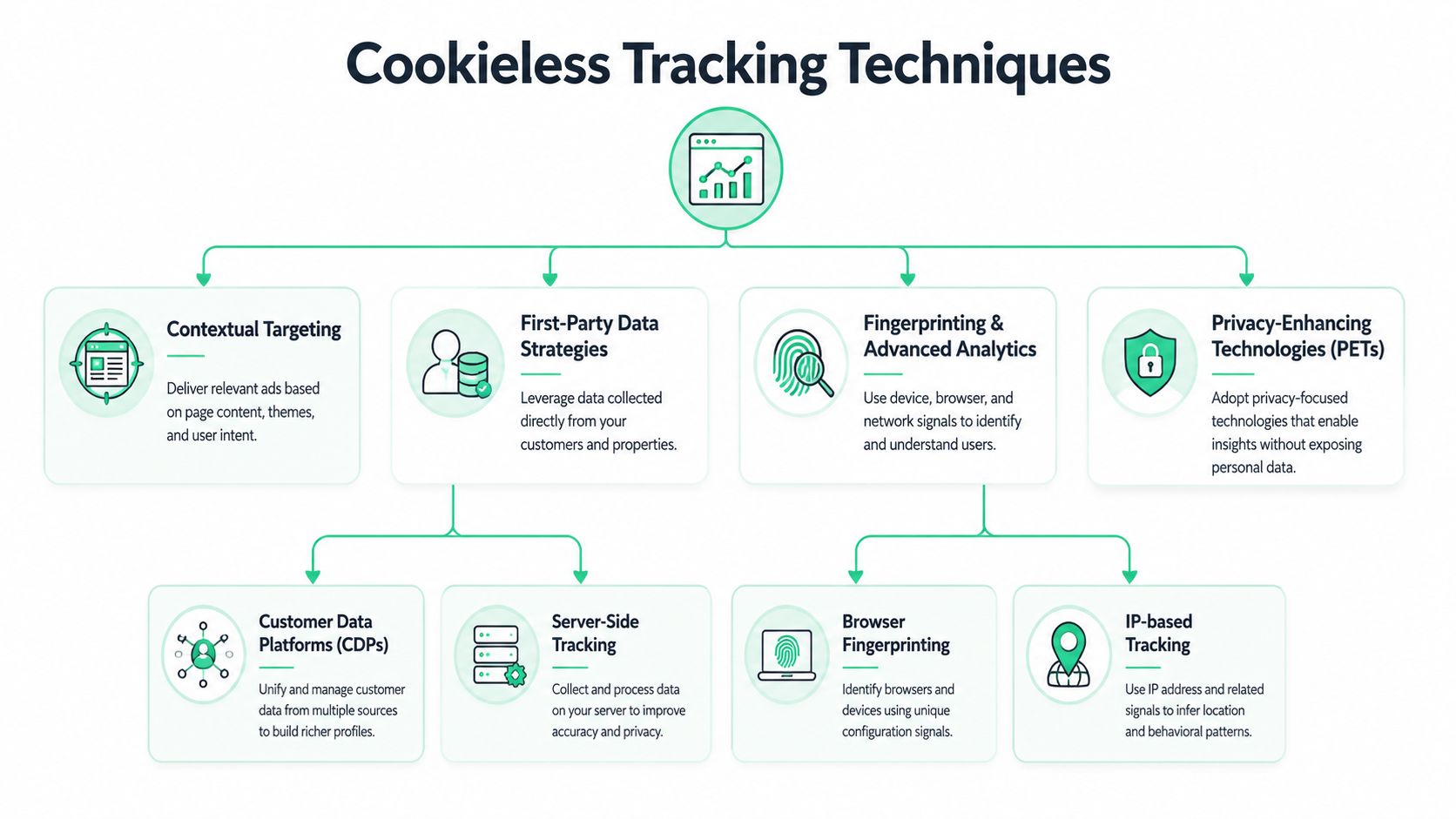
Cookieless tracking isn't one tool and it isn't one workaround. It's a measurement model built from several techniques that reduce reliance on browser-stored identifiers while still giving teams enough signal to analyze performance.
The easiest way to think about it is with a lock-and-key analogy.
From one master key to a keyring
The old setup relied heavily on one master key. Third-party cookies let many systems access the same user journey across sites and sessions. That made activation easier, but it also made privacy concerns much larger and measurement more dependent on browser permission.
Cookieless tracking works more like a keyring. Each key opens a specific part of the system:
- First-party data helps recognize known users and customer states within your own environment.
- Server-side signals let your backend pass events and identifiers without depending on the browser to deliver everything.
- Privacy-preserving APIs try to support advertising and measurement with less direct user-level tracking.
- Modeled or probabilistic methods fill gaps where deterministic identifiers don't exist.
No single key replaces the old master key. The goal is resilience, not one-to-one substitution.
What cookieless actually changes
In practical terms, cookieless tracking changes three things:
Where data is collected
More collection moves toward your own domain and server infrastructure.How identity is handled
Teams lean more on first-party identifiers, authenticated states, and aggregated signals.How success is measured
You stop expecting perfect user-level continuity everywhere and start designing for acceptable accuracy, governance, and observability.
That last point matters. Many teams still ask, “What replaces the cookie?” The better question is, “What combination of signals gives us reliable, compliant measurement for this use case?”
Cookieless tracking is less about finding a secret replacement and more about designing a stack that can survive privacy controls, browser restrictions, and implementation drift.
That's why some methods fit analytics, some fit attribution, and some should be used very carefully because legal and ethical risk can outweigh the data gain.
Anatomy of Cookieless Tracking Techniques
Some cookieless methods are practical and sustainable. Others are fragile, legally risky, or hard to operationalize. The right mix depends on whether you're trying to measure content performance, paid media efficiency, product engagement, or full customer journeys.
Server-side tracking
This is the most important technique for most serious measurement stacks. Instead of relying on browser-side JavaScript to send all analytics and advertising events directly to vendors, your site or app sends data to your server layer first. That server then forwards selected events to platforms like GA4 or ad destinations.
According to RedTrack's explanation of cookieless tracking, server-side tracking can achieve up to 100% data capture rates compared to 60-80% in client-side setups, and some platforms report a 30% improvement in measurement accuracy over client-side methods alone.
That doesn't mean every server-side implementation is automatically accurate. It means the architecture gives you a better chance to collect, transform, and route data without browser loss.
If you're weighing the operational side, this overview of server-side tracking fundamentals is a good companion to implementation planning.
First-party identifiers
First-party identifiers include login states, CRM-linked IDs, customer account references, and other signals collected within your own environment. They're valuable because they're rooted in direct user relationships rather than third-party cross-site tracking.
These identifiers work especially well in SaaS, ecommerce, subscriptions, and apps where users authenticate or repeatedly interact in known states. Their main limitation is obvious. Anonymous traffic won't magically become identifiable just because you want cleaner attribution.
Privacy-preserving APIs
Browsers and platforms are trying to support advertising use cases with more constrained data sharing. The idea is to allow some measurement and targeting functions without exposing broad user-level tracking across the web.
These approaches can help with aggregated reporting and platform interoperability, but they usually involve trade-offs in granularity, transparency, and control. Analysts should treat them as one input, not as the source of truth for business reporting.
Here's a short explainer from Trackingplan's channel that helps frame the server-side side of the shift:
Probabilistic methods and fingerprinting
Probabilistic tracking uses technical and behavioral signals to estimate whether interactions likely belong to the same user or journey. Fingerprinting takes that further by combining device and browser characteristics to create a persistent profile.
These methods can preserve continuity where cookies fail, but they come with major trade-offs. The first is explainability. Modeled joins are harder to validate than deterministic IDs. The second is governance. Fingerprinting in particular raises privacy concerns and can become difficult to justify under strict consent regimes.
Conversion APIs and clean rooms
Conversion APIs let servers send conversion events directly to advertising platforms. They're useful for improving signal delivery when browser-based pixels are blocked or degraded. But they don't solve identity design, event quality, or consent logic by themselves.
Data clean rooms serve a different purpose. They help organizations compare or analyze data across parties in controlled environments without exposing raw user-level records broadly. They're most relevant for larger advertisers, publishers, and regulated environments.
Comparison of Cookieless Tracking Methods
| Technique | How It Works | Pros | Cons | Best For |
|---|---|---|---|---|
| Server-side tracking | Sends events through your server before forwarding to analytics or ad platforms | Better control, less browser loss, stronger governance | More technical setup, more moving parts | Analytics, attribution, multi-platform event routing |
| First-party identifiers | Uses IDs created within your own domain or customer systems | Durable for known users, aligned with owned data | Limited for anonymous traffic | CRM, lifecycle analysis, customer journey stitching |
| Privacy-preserving APIs | Uses browser or platform-supported methods for restricted measurement | Lower privacy exposure than legacy cross-site tracking | Less granular, less transparent | Aggregated ad measurement |
| Probabilistic methods | Estimates identity or attribution from patterns and signals | Helps fill gaps where deterministic data is missing | Harder to validate, can drift over time | Large-scale modeling and directional analysis |
| Fingerprinting | Combines device and browser characteristics into a persistent signature | Can recognize returning devices without cookies | Significant privacy and consent risk | Narrow, high-scrutiny use cases |
| Conversion APIs | Sends conversions directly from server to platform endpoint | More resilient than browser-only pixels | Still depends on event design and consent accuracy | Ad platform conversion reporting |
| Data clean rooms | Compares data sets in a controlled environment | Useful for collaboration with tighter data access | Complex, resource-intensive | Enterprise measurement and partner analysis |
Don't choose techniques by novelty. Choose them by the reporting question you need to answer and the level of validation your team can actually maintain.
Navigating Privacy Laws and User Consent
Cookieless doesn't mean exempt from privacy law. It just means the tracking mechanism changed.
That distinction matters because some teams hear “no third-party cookies” and assume they've moved into a safer compliance zone by default. They haven't. If you collect, process, transmit, or enrich data in ways that can relate to a person or device, privacy obligations still apply.

Consent still governs the stack
Server-side collection often gives teams more control over what gets shared, but it also increases responsibility. You're deciding what to retain, what to hash, what to forward, and what to suppress when consent isn't present.
That's why I advise teams to treat consent as part of event architecture, not as a banner layer sitting above it. If the consent state doesn't travel with the event logic, someone will eventually forward data that shouldn't have left your environment.
The business risk is not theoretical. Since 2018, regulators have issued over €2.7 billion in GDPR fines, and more than 1,200 complaints were processed in 2024 alone, as noted in Pandectes' review of analytics cookies and privacy expectations.
Which cookieless approaches carry more risk
Not all cookieless methods are equal from a compliance standpoint.
- Low-friction approaches often include aggregated analytics, clearly disclosed first-party measurement, and tightly governed server-side routing.
- Higher-risk approaches include fingerprinting, opaque identity stitching, and data enrichment that teams can't clearly explain to legal, security, or users.
- Operationally risky approaches include any setup where consent logic exists in documentation but not in the actual implementation.
A good test is simple: can your team explain, event by event, what gets collected, why it's collected, where it flows, and how consent changes that flow?
Privacy-first measurement usually produces cleaner analytics because it forces teams to define ownership, purpose, and acceptable data use before launch.
Compliance is also a systems problem
Legal review matters, but so does infrastructure review. Server-side endpoints, webhook relays, tag gateways, and data forwarding services create new external surfaces. If those aren't assessed, your privacy posture can look stronger on paper than it is in production.
That's why teams building cookieless pipelines often pair analytics governance with technical reviews such as security assessments for external environments, especially when events are proxied through multiple systems before reaching analytics and ad platforms.
For governance workflows, it also helps to keep implementation and policy aligned through a dedicated privacy operations process. A resource like Trackingplan's privacy and compliance guidance fits naturally into this stage of day-to-day analytics management.
Your Migration and Implementation Checklist
Most failed migrations don't fail because the team picked the wrong buzzword. They fail because nobody mapped dependencies, set validation criteria, or assigned ownership across analytics, engineering, and marketing.
Treat cookieless tracking as a controlled migration project. Not a tag update.
1. Audit what your current setup actually does
Start with an inventory. List every analytics tool, ad pixel, conversion event, consent dependency, UTM rule, dataLayer field, and backend event source currently in use.
Look for three things:
- Critical reports that leadership already depends on
- Fragile dependencies such as redirects, cross-domain flows, and browser-only identifiers
- Redundant tracking that adds noise without serving a decision
This step usually reveals that teams are maintaining more tracking than they can verify.
2. Define your first-party data strategy
Cookieless tracking works better when your organization knows which first-party signals it owns and why they matter.
That usually means deciding how to use:
- Authenticated identifiers from account creation, subscriptions, or logins
- Relationship signals such as lead status, purchase history, or customer tier
- Declared data from forms, onboarding, or preference centers
Don't collect more just because it's technically possible. Collect what supports reporting, activation, and user experience with a clear consent basis.
3. Choose the stack by use case
A practical stack often includes server-side tagging, an analytics destination such as GA4 or Adobe, one or more ad platform conversion APIs, and a routing layer or CDP if the organization needs broader orchestration.
Selection criteria should include:
Control over data forwarding
Can you decide exactly what leaves your environment?Compatibility with consent logic
Can the stack suppress, redact, or transform events based on permissions?Operational maintainability
Can your team debug it without depending on one person?
If you're planning a move toward server-managed collection, this guide to migrating to server-side tagging best practices is a useful checklist to keep alongside your technical rollout.
4. Migrate in phases
Don't rip out browser-side tracking all at once unless you're prepared to lose your baseline.
A better sequence looks like this:
- Parallel run your new setup against the existing one
- Compare event coverage for priority flows like landing, signup, checkout, and purchase
- Document expected differences before stakeholders see them in reports
- Shift reporting dependencies gradually as confidence improves
Many teams often get impatient. They launch the infrastructure, skip the reconciliation phase, and only discover issues when month-end numbers don't match.
A migration is successful when the team can explain every material reporting difference before the business asks about it.
5. Update policy, consent, and team process
The implementation is not finished when events start arriving.
You still need to update:
- Privacy documentation so it reflects actual collection and forwarding behavior
- Consent flows so user choices map to your technical controls
- Change management so nobody ships a new event or pixel without review
- Ownership so someone is responsible for event specs, QA, and ongoing monitoring
Cookieless tracking becomes sustainable when measurement design, engineering changes, and privacy operations move together. If those workstreams split apart, the stack drifts quickly.
How to Ensure Your Cookieless Tracking is Reliable
Launching a cookieless stack is one problem. Trusting it a month later is the harder one.
A common blind spot for many teams emerges. The architecture looks modern. Events are arriving. Dashboards populate. But hidden implementation errors start accumulating in places nobody is actively checking.
Where reliability breaks
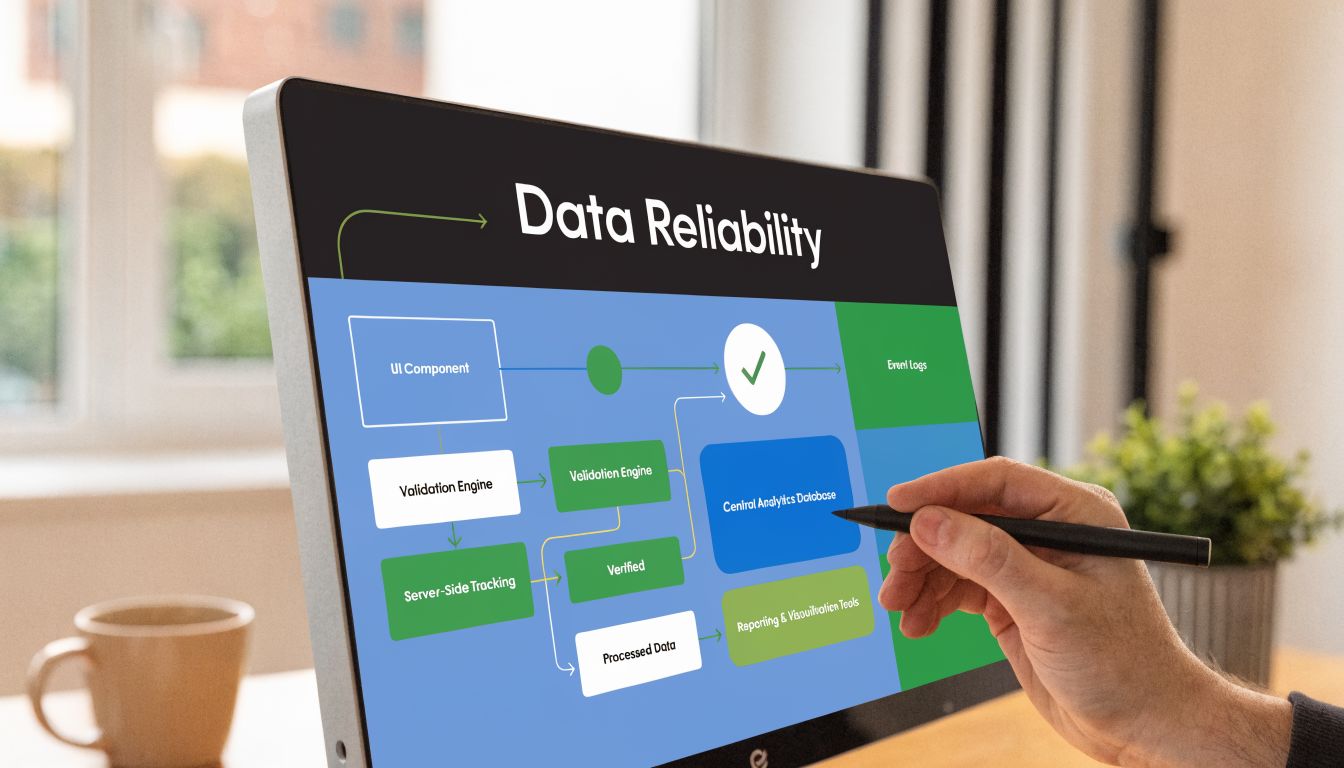
In a browser-heavy setup, teams were used to debugging tags in the page. In a cookieless stack, failures can happen across the client, server container, event gateway, webhook, destination mapping, consent layer, and reporting model.
The most common failure points are usually these:
- Schema mismatches where an event name exists but properties change without notice
- Broken pixels or webhooks that stop forwarding conversions downstream
- UTM and campaign tagging issues that break acquisition reporting before attribution even starts
- PII leaks caused by unhashed values or poorly filtered request parameters
- Consent misconfigurations where events continue to flow despite a denied state
According to Stape's discussion of cookieless tracking gaps, many guides focus on the methods but not the troubleshooting, and undetected anomalies like schema mismatches or broken pixels can lead to 20-30% data loss during migration.
What observability looks like in analytics
Hence, analytics observability becomes necessary. Not as a nice-to-have dashboard, but as an operating control.
A reliable process should tell you:
| Failure area | What to check |
|---|---|
| Event integrity | Are required events still firing with the expected properties? |
| Destination fidelity | Is the payload reaching GA4, ad platforms, and other endpoints consistently? |
| Consent behavior | Do denied users actually stop sending restricted data? |
| Data hygiene | Are PII, malformed values, or rogue parameters entering the stream? |
| Traffic anomalies | Did a sudden drop come from real behavior or from broken instrumentation? |
Many organizations attempt to manage this through manual QA, spreadsheet-based tracking plans, browser plugins, and occasional audits. That helps during implementation. It doesn't scale once multiple teams ship changes every week.
Tooling that fits this problem
This is one place where a dedicated monitoring layer matters. Trackingplan is an analytics QA and observability platform that automatically discovers implementations from the dataLayer through to destinations, monitors web, app, and server-side data flows, and alerts teams to issues such as missing events, schema mismatches, broken pixels, campaign tagging errors, PII leaks, and consent misconfigurations.
That kind of workflow is useful because cookieless tracking creates more hidden dependencies than older client-side setups did. If you don't monitor those dependencies continuously, you'll end up validating dashboards after the damage is already done.
The biggest risk in cookieless tracking isn't that data disappears completely. It's that bad data continues to look believable.
A practical reliability routine
A common workable ongoing routine looks like this:
Define your critical event set
Usually page views, lead events, checkout steps, purchases, and key media conversions.Monitor changes continuously
Don't wait for monthly audits.Alert on deviation, not just total failure
A renamed parameter can be as damaging as a missing event.Review consent and privacy behavior regularly
Especially after CMP, tag manager, or app release changes.Keep implementation docs current
Documentation that trails production isn't documentation. It's archaeology.
Frequently Asked Questions About Cookieless Tracking
The following practical FAQ addresses the questions teams usually ask once they move from theory into implementation.
| Question | Answer |
|---|---|
| Is cookieless tracking the same as server-side tracking? | No. Server-side tracking is one cookieless technique, not the entire category. Cookieless tracking includes first-party identifiers, privacy-preserving APIs, modeled approaches, conversion APIs, and more. |
| Does cookieless tracking mean we no longer need consent? | No. Cookieless does not mean consentless. If your data collection or processing falls under privacy law, you still need appropriate disclosures, controls, and consent handling where required. |
| Will cookieless tracking restore perfect attribution? | It depends. It usually improves resilience compared with legacy browser-only setups, but it won't recreate the old cross-site tracking model in full. The goal is more reliable measurement, not perfect surveillance. |
| Is fingerprinting a good replacement for cookies? | Usually no for general analytics and marketing measurement. It can create continuity, but it carries meaningful privacy and governance risk and is much harder to justify than first-party or server-managed approaches. |
| Can small teams adopt cookieless tracking without a large engineering team? | Yes, but they should keep the scope tight. Start with critical events, first-party data you already own, and a manageable server-side or privacy-first analytics setup. Complexity grows fast if you try to rebuild everything at once. |
| Does GA4 solve the cookieless problem by itself? | No. GA4 helps with event-based measurement and modeling, but reliability still depends on event design, consent setup, implementation quality, and how data is routed. |
| What's the most common mistake during migration? | Launching infrastructure without a validation plan. Teams often focus on sending events and forget to verify schema consistency, destination delivery, campaign tagging, and consent behavior. |
| How do I know my cookieless setup is working? | You need more than dashboards. Compare critical flows, monitor anomalies, validate payloads, review consent behavior, and watch for implementation drift across web, app, and server-side layers. |
Cookieless tracking works when teams stop treating measurement as a one-time tagging task and start managing it like production infrastructure. If you need a way to monitor analytics quality across web, app, and server-side implementations, Trackingplan is built for that operational layer. It helps teams detect broken pixels, schema mismatches, consent issues, campaign tagging errors, and other silent failures before they distort reporting.