
TL;DR:
- Data accuracy issues in martech mostly stem from fragmented processes, mismatched definitions, and broken measurement contracts rather than platform bugs.
- Maintaining accurate data requires continuous validation, regular audits, clear ownership, and operational discipline to detect and fix errors quickly.
Miscounted conversions, mismatched attribution numbers, and campaign metrics that don’t add up are rarely caused by a platform bug. The real culprit is almost always hiding deeper in your stack: fragmented processes, misaligned definitions, and broken measurement contracts spread across tools that were never designed to talk to each other cleanly. As data accuracy problems in martech stem from mismatched definitions, identity fragmentation, and broken schemas rather than any single tool failure, most teams keep chasing the wrong fix. If your team relies on digital measurement to drive attribution, optimize ad spend, or feed AI automation, getting this right isn’t optional.
Table of Contents
- What does ‘data accuracy’ mean in martech?
- Where most martech data accuracy fails: Root causes
- Validation: How to measure the accuracy of your martech data
- Client-side vs server-side tracking: Truths and traps in 2026
- Operational best practices: Audits, monitoring, and team coordination
- Why perfect accuracy isn’t the goal—and what separates high performers
- Accelerate data accuracy with purpose-built monitoring and audits
- Frequently asked questions
Key Takeaways
| Point | Details |
|---|---|
| Accuracy is multifaceted | It covers both event/measurement and contact/profile data for complete campaign attribution. |
| Root issues are systemic | Most data errors come from process gaps, not from tool glitches or bugs. |
| Validate, don’t assume | Regularly audit front-end data against backend sources and set explicit accuracy thresholds. |
| Operational discipline wins | High performers succeed through regular audits and rapid remediation, not chasing perfect records. |
| Specialized tools accelerate results | Purpose-built monitoring and audit solutions streamline maintaining high data quality. |
What does ‘data accuracy’ mean in martech?
Data accuracy in martech is not just about whether a number looks right. It’s a specific dimension of data quality, and confusing it with related concepts like completeness or timeliness leads teams to apply the wrong fixes at the wrong time.
Think of data quality as a set of distinct tests, each measuring something different. A practical way to evaluate accuracy in martech is to treat it as one dimension within a broader framework that includes completeness, uniqueness, validity, consistency, timeliness, and accuracy itself, with explicit tests and thresholds for each. Here’s how those dimensions break down in practical terms:
| Dimension | What it measures | Example failure |
|---|---|---|
| Accuracy | Does the data reflect reality? | Revenue events with wrong currency codes |
| Completeness | Are required fields populated? | Orders missing user IDs |
| Uniqueness | Are records deduplicated? | Same conversion counted twice |
| Consistency | Does data match across systems? | GA4 sessions differ from CRM entries |
| Timeliness | Is data fresh enough to act on? | Attribution data delayed 48 hours |
| Validity | Does data conform to schema? | Timestamps formatted incorrectly |
Accuracy, specifically, asks whether the captured value actually reflects what happened in the real world. A revenue event that fires correctly but records the wrong order value is a completeness win and an accuracy failure at the same time. Treating them as the same problem wastes diagnostic time.
This distinction matters for two types of data martech teams manage. First, event and campaign data: clicks, conversions, form submissions, funnel steps. Second, contact and profile data: the records powering your CRM, email segmentation, and personalization engines. Both types degrade, but in different ways and at different speeds.
“Martech ‘accuracy’ also applies to contact and profile data. Contact database decay is treated as an accuracy driver, not just a CRM hygiene issue.”
B2B contact accuracy is a silent killer. Without active maintenance, contact databases decay at 20 to 30% per year as people change roles, companies, and email addresses. That decay directly inflates your cost per acquisition and deflates campaign performance metrics in ways that are hard to trace back to the real cause.
Accurate data is also the foundation that analytics improves ROI across campaigns. When attribution models, bidding algorithms, and AI activation tools run on inaccurate inputs, they amplify errors rather than insights. The downstream consequences compound quickly.
Understanding what explained data integrity means in marketing analytics gives you a cleaner mental model for diagnosing where your measurement stack is leaking.
Where most martech data accuracy fails: Root causes
Now that we know what accuracy means, it’s crucial to understand where things typically break down. Most accuracy failures share a common pattern: they aren’t bugs. They’re process and system failures that accumulate quietly until something obvious finally breaks.
Identity fragmentation
When a single user appears under different keys across your stack, every downstream report is wrong. A visitor might be tracked as an anonymous ID in your analytics platform, a different cookie in your ad network, and a contact record in your CRM, each with no reliable bridge between them. Identity fragmentation and broken measurement contracts are primary drivers of attribution loss, not platform limitations.

The result is ghost users, split sessions, and attribution credit landing in the wrong channel. Multi-touch models built on fragmented identity don’t reflect real customer journeys. They reflect the gaps in your measurement architecture.
Schema drift
Schema drift happens when the structure of your data changes without a formal update process. A developer renames an event property. A new team starts sending a field with a different data type. A third-party integration updates its API and stops sending a field your downstream tools depended on. None of these are “bugs” in the traditional sense. They’re coordination failures.
Over time, these small shifts cause your dashboards to show trends that don’t exist, hide trends that do, and make historical comparisons unreliable. Most teams only discover schema drift when a stakeholder asks why a metric suddenly looks different.
Deduplication and merge logic failures
Deduplication rules determine whether a conversion gets counted once or multiple times. Merge logic determines which contact record “wins” when duplicates exist in your CRM. When these rules are poorly defined or inconsistently applied, you get double counting on the conversion side and fragmented profiles on the contact side.
Here’s a quick comparison of how accurate setups differ from broken ones:
| Setup element | Accurate implementation | Common failure mode |
|---|---|---|
| Event deduplication | Unique event IDs matched server-side | Same event fired twice, both counted |
| User identity | Single canonical ID bridged across tools | Multiple IDs for same user, never merged |
| Schema contracts | Documented, versioned, enforced in CI/CD | Informal, changed without notice, never validated |
| Contact merging | Rules-based with clear field priority | Last-write-wins with no audit trail |
| Attribution windows | Consistent across ad platform and analytics | Different windows in each tool, causing mismatch |
Profile and contact decay compounds these structural issues. Even if your schema is clean and your identity graph is solid, stale contact data causes you to target the wrong people with the wrong messages. Enrichment strategies that keep records fresh are as much an accuracy issue as anything happening at the pixel level.

Pro Tip: Document your schema contracts formally, as a living spec that every team touching the data stack must update when making changes. Treat schema changes like code deployments: reviewed, versioned, and communicated.
You can explore the most common data issues and fixes across modern stacks, and look deeper at common data errors that affect measurement quality in ways teams rarely anticipate.
Validation: How to measure the accuracy of your martech data
Once the causes are clear, the next step is to validate whether you’re actually measuring what you think you are. Many teams skip this step because it’s uncomfortable. Validation often reveals that the data you’ve been reporting on for months is materially wrong.
Start with a realistic expectation: perfect accuracy is structurally impossible. Browser and privacy controls create systematic undercounting and misattribution in client-side tools like GA4. Ad blockers, consent opt-outs, and cookie restrictions all suppress tracking in ways you cannot fully compensate for from the browser. This isn’t a reason to stop validating. It’s a reason to set baselines instead of chasing perfect numbers.
Here’s a practical validation framework:
-
Establish your source of truth. Pick a backend system, such as server logs, your CDN, or your application database, that captures events independently of your front-end tracking. This becomes the reference against which you measure everything else.
-
Run a gap analysis. Compare event volumes from your analytics platform against your backend source of truth over a fixed period. Identify the consistent gap percentage and whether it’s stable or growing.
-
Test each data quality dimension separately. Don’t lump accuracy with completeness. Write explicit tests: Are required fields populated? Are values within expected ranges? Are event names matching your documented schema?
-
Set thresholds for acceptable variance. A 5% gap between GA4 sessions and server-side sessions might be expected given privacy controls. A 25% gap is a red flag. Define these thresholds in advance so anomalies trigger alerts rather than debates.
-
Audit your deduplication and identity logic. Manually trace a sample of conversions from front-end event to back-end record. Verify the identity key is consistent at every step and that the conversion isn’t counted more than once.
-
Segment by channel and device type. Overall accuracy numbers can mask serious problems in specific segments. A tracking implementation that works perfectly on desktop Chrome might be largely invisible on Safari iOS due to ITP (Intelligent Tracking Prevention) restrictions.
It’s also worth noting that server-side tracking purchase accuracy depends on event integrity, identity linkage, consent-aware processing, and deduplication. Moving to server-side doesn’t automatically improve your numbers. The same validation steps apply.
For a deeper look at comparing approaches, the guide on server-side vs pixel tracking walks through where each method creates risk. And a thorough audit checklist can structure your validation process from start to finish. Pairing validation with strong website audit strategies gives you a fuller picture of where measurement gaps originate.
Pro Tip: Always segment your accuracy analysis by traffic source or marketing channel before drawing conclusions. A global 8% discrepancy might be hiding a 40% gap in paid social traffic that’s actively distorting your attribution model.
Client-side vs server-side tracking: Truths and traps in 2026
The tactic you choose for technical deployment directly impacts measurement challenges. The debate between client-side and server-side tracking has become one of the most misunderstood topics in the martech space. Many teams treat server-side as an automatic upgrade. It isn’t.
Here’s the core distinction: server-side tracking changes where events are processed, not what those events mean or whether they’re valid. The measurement contract, the schema, the identity linkage, and the deduplication logic all still need to be correct. Moving event processing to your server doesn’t fix a broken schema or a fragmented identity graph.
Key truths about each approach:
Client-side (pixel-based) tracking:
- Simple to implement and widely supported by ad platforms and analytics tools
- Vulnerable to ad blockers, browser privacy controls, and consent restrictions
- Can capture rich browser-side context like scroll depth, click coordinates, and session behavior
- Requires strong consent management to remain privacy-compliant
- Works well as part of a hybrid setup when its limitations are understood and measured
Server-side tracking:
- Bypasses client-side privacy controls, which can improve conversion capture rates
- Requires clean identity linkage: the server needs a reliable user key to tie events to profiles
- Introduces new deduplication challenges when running alongside client-side tags
- Does not automatically produce more accurate data if event integrity is poor
“Server-side tracking can improve conversion capture vs pixel-only, but accuracy depends on event integrity, identity linkage, consent-aware processing, and deduplication that prevents double counting or attribution breaks.”
The most dangerous scenario is a hybrid setup where IDs don’t align perfectly. When a client-side tag uses a cookie-based user ID and a server-side event uses an authenticated user ID with no mapping between them, you end up with ghost users in your reports. Conversions get attributed to sessions that “don’t exist” in your analytics platform, making your data look worse than a pixel-only setup.
The comparison between server-side vs pixel approaches is far more nuanced than most vendor documentation admits. The right choice depends on your identity architecture, your consent framework, and whether you have the operational discipline to maintain both sides of a hybrid setup correctly.
Operational best practices: Audits, monitoring, and team coordination
For sustainable accuracy, teams need practical systems and repeatable routines. Tooling alone won’t fix accuracy issues. The teams that consistently maintain clean measurement data do it through operational discipline, not because they picked the right platform.
Here’s what that operational discipline looks like in practice:
-
Schedule regular audits. Regular martech audits and capability-level measurement are emphasized as key to improving ROI and reducing problems caused by low utilization and fragmented processes. Set a quarterly audit cadence at minimum, and trigger an unscheduled audit whenever a major campaign or tech change occurs.
-
Implement real-time monitoring. Audits catch historical problems. Monitoring catches problems before they corrupt live campaign data. Set up alerts for traffic spikes or drops, event volume anomalies, and schema mismatches that fire the moment something breaks rather than at your next scheduled review.
-
Assign clear data ownership. Every event, every schema, every integration should have a named owner. When something breaks, ownership determines who diagnoses and fixes it. Without ownership, accuracy issues sit in a gray area between marketing, analytics, and engineering for weeks.
-
Define and enforce measurement standards. Create a documented taxonomy for events and properties. Require schema reviews before any new tracking implementation goes live. Treat measurement standards the same way engineering teams treat coding standards: non-negotiable, reviewed, and enforced.
-
Build enrichment workflows for contact data. For B2B teams especially, contact decay at 20 to 30% per year means your database is wrong about a quarter of your contacts within twelve months. Build automated enrichment pipelines that update job titles, company data, and contact status on a rolling basis.
-
Bridge the gap between marketing, analytics, and IT. Most accuracy failures happen at team boundaries. Marketing requests a new pixel. IT implements it slightly differently than intended. Analytics discovers the discrepancy six weeks later during a campaign debrief. A shared measurement brief that defines expected outputs before implementation prevents this cycle.
Pro Tip: Before any major campaign launch, run a pre-flight checklist that verifies every tracking event fires correctly, identity keys are consistent, and deduplication rules are active. This takes two hours and can save weeks of post-campaign confusion.
The resources on regular digital audits, tag audit tools, and website audit best practices provide detailed frameworks for structuring these routines. For broader context on how accuracy fits into larger challenges, overcoming data challenges in 2026 covers the operational dimension well.
Why perfect accuracy isn’t the goal—and what separates high performers
Here’s an uncomfortable truth most analytics content avoids: your data will never be perfectly accurate, and the teams chasing perfect parity across platforms are wasting resources that could be spent on something that actually moves the needle.
Accuracy issues are structural limits in many cases: privacy regulations, consent requirements, ad blockers, attribution modeling assumptions, and browser restrictions all create gaps that no amount of engineering can close. The right target is stable, measurable gaps and repeatable validation, not perfect parity between your ad platform and your analytics tool.
Elite marketing and analytics teams don’t try to eliminate measurement gaps. They measure the gaps, document them, and establish baselines. When a gap shifts, they know immediately because they’re monitoring for baseline drift, not just absolute numbers. That’s a fundamentally different mental model from the “why don’t these numbers match” conversation that consumes hours in team meetings every week.
The discipline that separates high performers isn’t tool selection. It’s fast remediation. When something breaks, the best teams detect it within hours, not days, because they have monitoring in place. They diagnose it quickly because their data is documented and their schemas are versioned. And they fix it fast because ownership is clear and processes are defined.
This also means investing in the cost of low data quality conversation at the leadership level. Accuracy isn’t a technical concern that lives in an engineering ticket. It’s a business risk that affects ad spend efficiency, attribution models, and the reliability of every AI-driven decision your marketing stack makes. Teams that frame it this way get the resources they need. Teams that treat it as a “data hygiene” task don’t.
The other thing elite teams do differently: they separate structural accuracy limits from fixable accuracy failures. Privacy-driven undercounting in GA4 is structural. A conversion event firing twice because of a misconfigured tag is fixable. Knowing which bucket a problem falls into determines where you invest your diagnostic time and what a realistic resolution looks like.
Accelerate data accuracy with purpose-built monitoring and audits
Accurate measurement at scale requires more than good intentions. It requires systems that catch problems automatically, surface issues before they corrupt campaign data, and give your team the context to act fast.
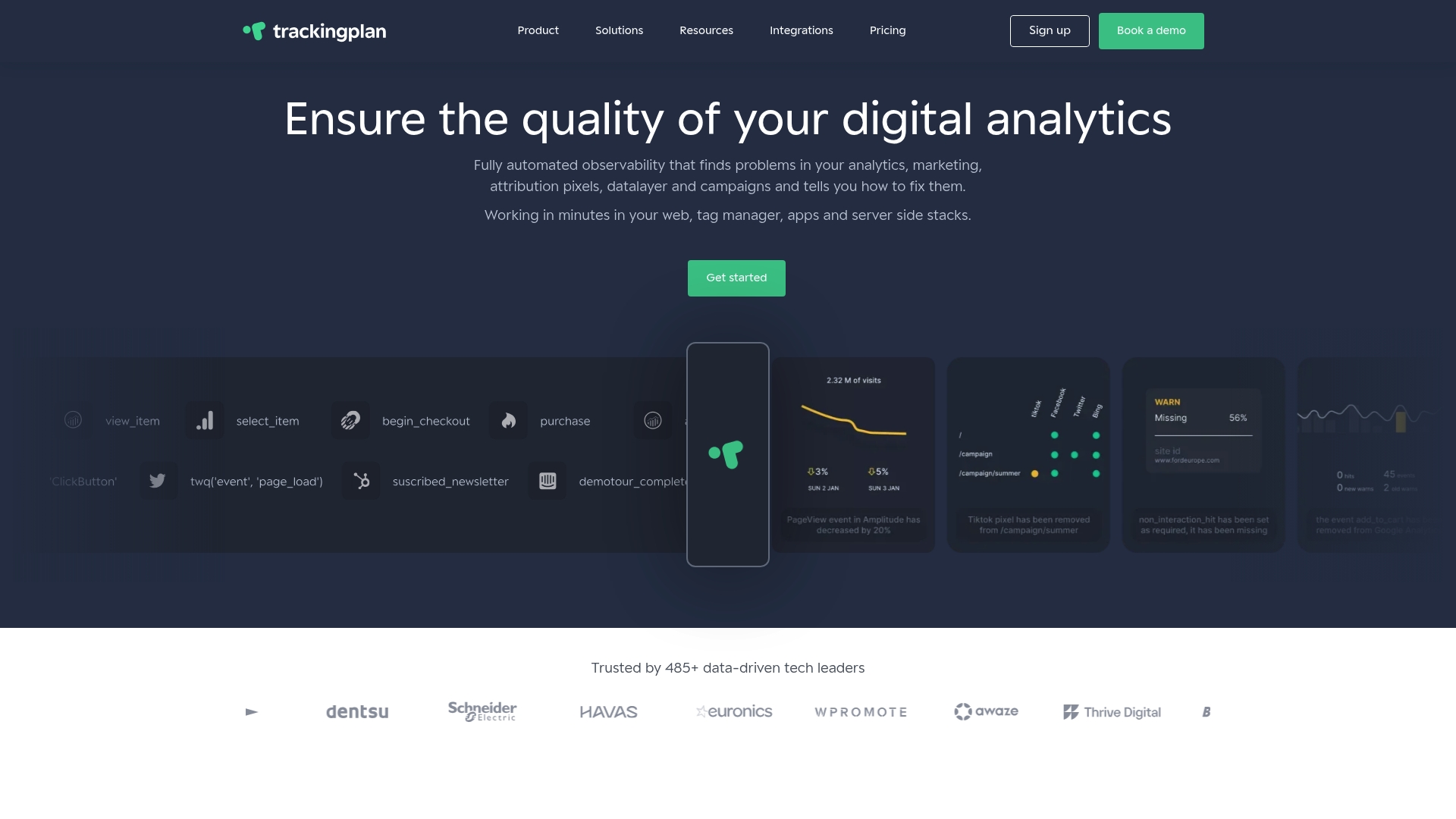
Trackingplan is built specifically for this. By automatically monitoring your tracking implementations across web, app, and server-side environments, it detects schema mismatches, broken pixels, missing events, and data anomalies in real time, sending alerts directly to Slack, Teams, or email the moment something goes wrong. Whether you need to audit your full analytics data quality tools ecosystem, set up continuous web tracking monitoring across all your properties, or use an AI debugger for tracking to diagnose root causes fast, Trackingplan reduces the manual effort that keeps accuracy problems alive. Accurate data is a system, and Trackingplan is designed to keep that system running.
Frequently asked questions
What factors most commonly cause inaccurate data in martech stacks?
Mismatched definitions, identity fragmentation, and broken schemas across tools are the primary causes, alongside the absence of systematic audits and ownership over measurement standards.
How should marketing teams validate their analytics data for accuracy?
Compare front-end event volumes against a backend source of truth such as server logs, set defined variance thresholds, and run scheduled audits to catch drift before it compounds.
Is server-side tracking always more accurate than client-side?
No. Server-side accuracy depends on event integrity, identity linkage, consent-aware processing, and deduplication logic. Without those elements in place, server-side setups can introduce new error types rather than reducing them.
How quickly does contact data decay without maintenance?
B2B contact databases decay at 20 to 30% annually without active enrichment, meaning nearly a third of your contact records may be inaccurate within a year of their last update.
What’s the realistic goal for data accuracy in complex marketing environments?
Rather than chasing perfect parity, target stable, measurable baseline gaps and invest in rapid detection and remediation when those baselines shift.