
TL;DR:
- Third-party cookies are declining, prompting marketers to adopt privacy-first measurement strategies and rebuild attribution models.
- Using server-side tracking, aggregate modeling, and browser-based APIs like Topics and Protected Audience, teams can maintain campaign insights without relying on cross-site user identifiers.
Third-party cookies are fading fast, and most marketing teams are still running measurement playbooks built on a foundation that no longer exists. The instinct is to panic, but the reality is more nuanced: the loss of deterministic, cross-site user tracking doesn’t mean the end of effective advertising. It means the beginning of a more honest, durable approach to measurement. This article breaks down exactly what cookieless advertising means in practice, how Privacy Sandbox and its APIs actually work, and how to rebuild your attribution stack using server-side tracking, aggregate modeling, and causal validation so you can keep optimizing campaigns with confidence.
Table of Contents
- Why cookieless advertising is transforming digital marketing
- Privacy-first frameworks: Privacy Sandbox, Topics, and Protected Audience
- Redesigning measurement: Attribution in a cookieless world
- Implementing effective tracking: First-party and server-side solutions
- Synthesizing your stack: Building for agility and compliance
- The uncomfortable truth: Precision is gone—focus on what works in a cookieless world
- How Trackingplan helps you thrive in cookieless advertising
- Frequently asked questions
Key Takeaways
| Point | Details |
|---|---|
| Rethink measurement | Stop depending on user-level cookies and build a layered framework for credible attribution. |
| Test privacy-first tools | Experiment with Privacy Sandbox APIs and server-side tracking to uncover new opportunities. |
| Model for reality | Rely on aggregate and modeled approaches to accurately allocate budget and optimize campaigns. |
| Audit and adapt | Regularly verify compliance and agility as privacy and tracking technologies evolve. |
Why cookieless advertising is transforming digital marketing
Cookieless advertising refers to any approach to targeting, measurement, and optimization that does not rely on third-party cookies for cross-site user identification. This distinction matters because most advertising infrastructure built over the last two decades was designed around a simple principle: a small file placed in a user’s browser could track that person across websites, enabling marketers to build detailed user profiles, measure multi-touch journeys, and retarget with precision.
That system is breaking down from multiple directions at once. Safari blocked third-party cookies by default in 2020. Firefox followed. Chrome, which still holds a large share of browser traffic globally, has moved toward restricting them through Privacy Sandbox APIs and user-controlled settings. Beyond browsers, regulatory pressure from GDPR, CCPA, and a growing list of national privacy laws has made cookie-based data collection legally complex and increasingly difficult to defend to users.
“Google’s Privacy Sandbox is designed to reduce cross-site and cross-app tracking while still enabling advertisers and developers to build digital businesses.” (Privacy Sandbox initiative statement)
This framing is important. The Privacy Sandbox implications aren’t purely restrictive. The goal is not to destroy advertising but to decouple relevance and measurement from individual cross-site identity. For marketers who understand the distinction, that’s actually an opportunity.
The core challenge is that deterministic tracking, meaning the ability to follow a specific, identified user across multiple sessions and touchpoints, was the backbone of modern attribution models. When that signal degrades or disappears, the following real-world problems emerge:
- Attribution gaps: Conversions that can’t be connected to the original touchpoint because user-level journey data is broken
- Targeting limitations: Lookalike audiences, frequency capping, and sequential messaging all rely on cross-site identification that no longer works reliably
- Inflated last-click attribution: As middle-of-funnel signal erodes, credit collapses onto the final touchpoint, distorting budget decisions
- Reach and frequency issues: Without a shared identifier, avoiding overexposure becomes guesswork across ad platforms
- Creative personalization breakdown: Dynamic creative systems that use behavioral data lose accuracy when behavioral signals are unavailable
This isn’t just a compliance issue you can resolve by checking a consent box and moving on. Every layer of campaign effectiveness, from audience construction to creative sequencing to post-campaign attribution, is affected. The teams that recognize this early have a real competitive advantage over those still trying to patch cookie-dependent systems.
Privacy-first frameworks: Privacy Sandbox, Topics, and Protected Audience
Privacy Sandbox is Google’s architecture for replacing third-party cookie functionality with a set of browser-based APIs that protect individual identity while still enabling some forms of relevance and measurement. Understanding how it actually works changes the way you think about what data you have access to and when.
The Topics API assigns a browser a small set of interest categories based on recent browsing history. When a user visits a publisher site, the ad tech system can request a topic from the browser. Crucially, this happens on-device and the raw browsing history never leaves the user’s machine. Advertisers can use topics to inform relevance without knowing exactly which sites a user visited.
The Protected Audience API (formerly FLEDGE) handles remarketing use cases. Advertisers can add users to interest groups on-device. When those users visit a publisher site, the browser runs a local auction to select the most relevant ad. Again, the individual user data stays in the browser, not in any ad server or DSP.
| Feature | Third-party cookies | Topics API | Protected Audience API |
|---|---|---|---|
| Targeting granularity | Individual user-level | Broad interest category | Interest group (on-device) |
| Cross-site identity | Yes | No | No |
| Privacy protection | Low | High | High |
| Remarketing support | Yes | No | Yes |
| Attribution support | User-level | Aggregate only | Aggregate only |
| Measurement availability | Deterministic | Limited/modeled | Limited/modeled |
The measurement implications here are significant. As the Privacy Sandbox relevance and measurement FAQs confirm, Topics and Protected Audience systems operate with seller and publisher-controlled signals and privacy-preserving reporting. This means your dashboard numbers will look different and the reconciliation process requires new workflows.
One of the most common mistakes teams make is treating the Privacy Sandbox as a drop-in replacement for cookie-based systems. It is not. It requires rethinking the signals you use, the questions you ask of your data, and the level of precision you expect from your reporting.
Pro Tip: Start small. Before scaling Privacy Sandbox adoption, run controlled tests on one or two publisher-controlled platforms where you have direct access to reporting infrastructure. Compare Topics-based campaign performance against your existing benchmarks using consistent conversion windows and holdout groups. This gives you calibrated baselines before you commit budget to a fundamentally different signal set.
Redesigning measurement: Attribution in a cookieless world
Legacy multi-touch attribution (MTA) models were built on the assumption that you could stitch together a user’s complete journey across channels, devices, and touchpoints using persistent cross-site identifiers. Remove those identifiers and the model doesn’t just become less accurate. It becomes structurally broken.
As research on attribution challenges explains, attribution quality degrades when cookie-dependent stacks rely on deterministic user-level journeys, and some practitioners argue this produces “structural damage” and dashboard numbers that may not reconcile to real outcomes. This is a polite way of saying your MTA dashboard might look fine while being genuinely misleading.
| Approach | Signal type | Accuracy level | Cookie dependency | Best use case |
|---|---|---|---|---|
| Deterministic MTA | User-level cross-site | High (when cookies work) | Critical | Pre-2022 environments |
| Consent mode modeling | Consented + modeled | Moderate to high | Low | Post-consent, first-party signals |
| Marketing mix modeling | Aggregate channel-level | Directionally accurate | None | Budget allocation decisions |
| Incrementality testing | Causal, geo-lift | High (for tested channels) | None | Validating channel contribution |
“Attribution quality degrades when cookie-dependent stacks rely on deterministic user-level journeys; practitioners argue this produces ‘structural damage’ and dashboard numbers that may not reconcile to real outcomes.” TheMarketingJuice
So how do you rebuild measurement properly? Here’s a practical numbered sequence for organizations transitioning now:
-
Implement server-side event capture first. Move pixel firing from the browser to your server. This gives you complete control over what data is collected and transmitted, independent of browser restrictions. It also improves data fidelity because browser extensions, ad blockers, and cookie restrictions can’t interfere.
-
Set up consent mode with proper behavioral modeling. For users who don’t consent to tracking, consent mode allows platforms like Google Ads to model conversions using aggregate patterns from consented users. This fills measurement gaps without collecting data illegally.
-
Run a baseline marketing mix model (MMM). MMM uses regression analysis on aggregate spend, channel activity, and business outcomes to attribute performance across channels without user-level data. It’s slower and less granular than MTA but genuinely reliable.
-
Validate with incrementality tests. Run geo-lift or holdout experiments to confirm whether a channel is actually driving incremental conversions. Use this to cross-check your MMM outputs and adjust budget allocation.
-
Document what precision you’ve sacrificed. Be explicit with stakeholders about what questions your new stack can and cannot answer. Pretending the new model has the same precision as cookie-based MTA creates trust problems when results diverge.
Thinking carefully about measuring marketing effectiveness this way forces your team to ask better questions. Not “which ad did this user click?” but “is this channel contributing to outcomes at the channel level?” That shift in question quality is one of the real hidden benefits of cookieless transition.
Pro Tip: Stop optimizing for dashboard precision and start optimizing for decision quality. A marketing mix model that helps you correctly reallocate 15% of budget to a higher-performing channel is worth more than a pixel-perfect MTA that’s secretly miscounting conversions because of broken cookie chains.
Implementing effective tracking: First-party and server-side solutions
First-party data is data you collect directly from your own users through their consented interactions with your owned channels, your website, app, CRM, email platform, or loyalty program. It is the most durable signal available in a cookieless environment because it doesn’t depend on cross-site tracking at all.

Server-side tracking takes this further by moving the technical implementation of data collection off the user’s browser and onto your server infrastructure. When a user completes a purchase, instead of firing a conversion pixel in the browser (which can be blocked or degraded), your server sends the conversion event directly to the relevant platform APIs. This approach improves coverage, reduces data loss, and gives your team full control over what data flows where.
Key benefits of layering first-party and server-side approaches:
- Durability: First-party data isn’t affected by browser cookie policies or user-installed blockers
- Privacy compliance: You control exactly what data is collected and transmitted, making consent management cleaner and more auditable
- Data completeness: Server-side event capture sees 100% of qualifying events, not just the percentage that survive browser-side blocking
- Signal quality: Clean, validated events from your own infrastructure tend to be more accurate than tag-manager-fired pixels on complex page loads
- Platform reach: Server-side APIs for Meta, Google, TikTok, and others accept first-party signals directly, supporting attribution even without cookies
As cookieless measurement stack guidance makes clear, layering first-party and server-side event capture for consented users with consent-mode modeling for non-consented traffic, and then applying marketing mix modeling for channel-level attribution, is the current best practice for teams operating in privacy-first environments.
For consented users, the goal is complete, server-side event capture tied to first-party identifiers like hashed emails or logged-in user IDs. For non-consented users, consent mode modeling fills the gap using aggregate patterns. For channel-level strategy, MMM operates entirely on aggregate spend and outcome data, no user-level signals required at all.
Pro Tip: Layer all three approaches instead of choosing one. Consent mode, server-side capture, and marketing mix modeling answer different questions and cover different gaps. When they agree, you have strong signal. When they disagree, you have an audit trigger. Either way, you’re better informed than a team relying on a single measurement approach.
Resources like optimizing server-side tracking and server-side tracking best practices go deeper on implementation specifics. And for a broader view of what this means for your analytics program, the discussion on analytics in a cookieless world is worth your time.
Synthesizing your stack: Building for agility and compliance
Building a modern measurement stack is less like installing software and more like designing infrastructure. You’re layering systems that serve different purposes, and the goal is resilience, not perfection. Here’s what a practical, cookieless-ready stack looks like in recipe form:
- Server-side event collection feeding directly to your data warehouse and platform ad APIs
- Consent mode v2 configured properly for both Google and non-Google platforms, with behavioral modeling enabled for non-consented traffic
- CRM-backed first-party identifiers (hashed emails, customer IDs) used for match-back and audience building within platform clean rooms
- Incrementality experiments running on a rotating schedule to validate your highest-spend channels every quarter
- Marketing mix models updated at least quarterly to capture channel-level shifts in performance
The common implementation pitfalls we see teams fall into are consistent and avoidable. First, many organizations implement server-side tracking but forget to model non-consented traffic, leaving a large, invisible gap in their measurement. Second, teams often skip causal validation entirely, trusting their modeled attribution numbers without ever running an experiment to confirm them. Third, organizations build their stack once and never audit it, leaving silent failures to compound over months.
As the practical transition strategy research shows, the most actionable approach is not to “replace cookies with one magic ID” but to redesign measurement as a stack: server-side event capture plus modeled and aggregate attribution plus causal validation so you can optimize and allocate budget credibly under reduced precision.
Pro Tip: Schedule a quarterly tracking audit as a standing team ritual, not just a one-time project. Pixels drift, consent banners break, server-side integrations fail quietly, and ad platform API changes happen without notice. Regular audits using compliance verification for 2026 and consent mode validation tools catch these issues before they distort your decision-making.
Agility is the key word here. Privacy regulations evolve. Browser APIs change. Ad platform measurement capabilities shift with each product update. The teams that build flexible, layered stacks and maintain a habit of testing and auditing will outperform those chasing a single definitive solution that doesn’t exist.
The uncomfortable truth: Precision is gone—focus on what works in a cookieless world
Here is the uncomfortable reality that most vendor marketing won’t tell you: the era of granular, deterministic, user-level attribution across the open web is genuinely over. Not temporarily disrupted. Over. And teams that spend the next two years trying to rebuild that precision through workarounds like probabilistic fingerprinting or aggressive identity resolution are wasting time and creating compliance risk.
The better question isn’t “how do we get our precision back?” It’s “what decisions were we actually making with that precision, and are we making them better now?” In our experience, the answer is often surprising. Many MTA dashboards that felt precise were actually producing confidence in numbers that didn’t reflect real incremental outcomes. The cookie loss has forced a more honest accounting.
The Privacy Sandbox measurement approach confirms this shift. Topics and Protected Audience systems operate with privacy-preserving reporting, which means reconciling performance across platforms now requires new measurement processes that are aggregate by design. This isn’t a bug. It’s a feature for teams willing to operate at the right level of analysis.
What actually works now is a test-and-learn culture grounded in channel-level validation. Run incrementality tests. Build MMM baselines. Use effective measurement strategies to answer the question “is this channel driving real outcomes?” rather than “which ad did this exact user click?” Embrace uncertainty as information rather than noise to be optimized away.
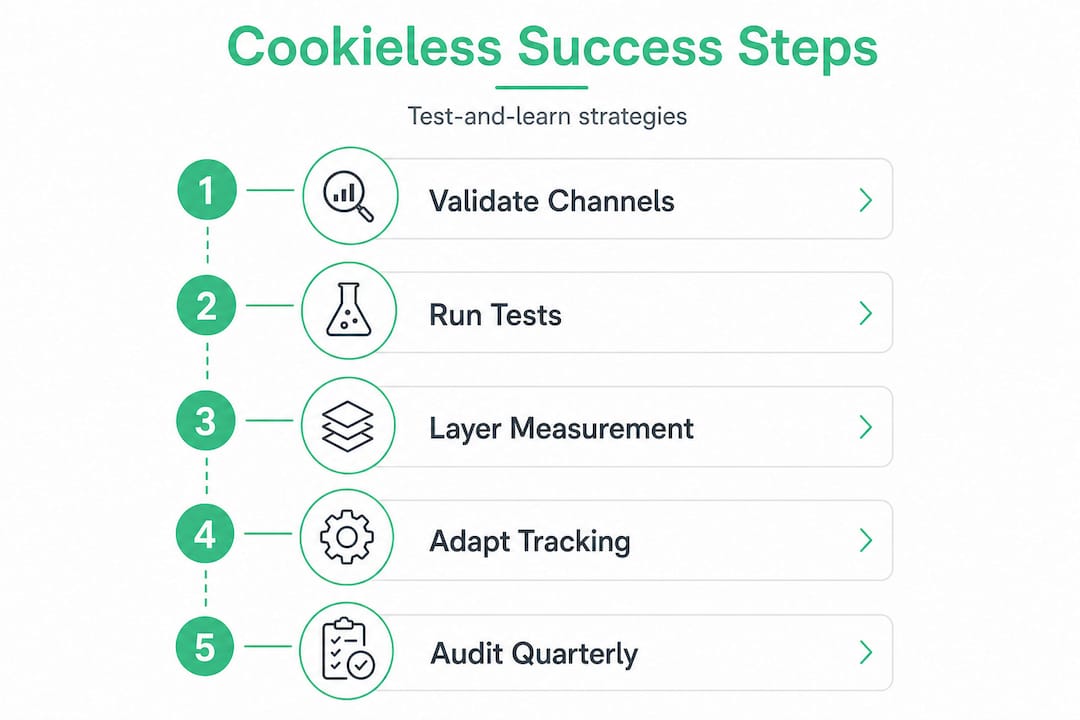
The teams winning in 2026 aren’t the ones with the most sophisticated attribution model. They’re the ones who understand which questions their models can credibly answer, audit their stack regularly, and make budget decisions from a position of honest uncertainty rather than false precision.
How Trackingplan helps you thrive in cookieless advertising
Transitioning to a cookieless measurement stack is only as strong as the quality of the data flowing through it. Broken pixels, misconfigured server-side events, and consent mode errors are silent killers that corrupt every model sitting downstream.
Trackingplan continuously monitors your entire analytics implementation, from browser-side pixels to server-side event streams, alerting your team the moment something breaks, drifts, or mismatches your expected schema. Whether you’re validating a new consent mode setup, auditing your server-side tracking for coverage gaps, or checking that your Privacy Sandbox integrations are firing correctly, Trackingplan’s automated discovery and real-time alerts keep your stack honest. Explore the full range of analytics integration tools, review the privacy hub resources for compliance guidance, and see how Trackingplan works to protect your measurement quality at every layer.
Frequently asked questions
What is cookieless advertising?
Cookieless advertising uses privacy-friendly methods like first-party data, contextual signals, and browser-based APIs instead of third-party cookies for targeting and measurement. As the Privacy Sandbox overview confirms, the goal is to enable digital advertising while reducing cross-site and cross-app tracking.
How can I measure ad effectiveness without cookies?
Use server-side tracking for consented users, model conversions for non-consented traffic, and apply media mix or incrementality modeling for overall effectiveness. As cookieless measurement guidance recommends, layering all three approaches gives the most credible and complete picture.
Are measurement dashboards less accurate without cookies?
Yes, dashboards that relied purely on cookie-based attribution become less reconcilable with real-world results over time. As attribution research shows, this can produce structural measurement damage, which is why aggregate modeling is now the preferred approach.
What does the Privacy Sandbox mean for advertisers?
It introduces browser-based APIs like Topics and Protected Audience that allow relevant targeting while preserving privacy, but it also requires adopting new measurement processes. The Privacy Sandbox FAQs provide detailed guidance on how relevance and measurement work within these new systems.
Should I abandon attribution modeling now?
No. Shift to aggregate and probabilistic approaches that combine first-party signals, modeled data, and causal testing. As Digital Applied’s guidance outlines, layering server-side capture with consent-mode modeling and marketing mix modeling gives you credible attribution without depending on cross-site user identity.