
TL;DR:
- Real-time monitoring enables immediate campaign adjustments to reduce ad spend waste.
- AI anomaly detection helps identify genuine issues, but human review is essential.
- Brands using real-time data see up to 25% higher ROI and improved customer retention.
Stale campaign data costs real money. Every hour your team waits for a batch report, underperforming ads keep running, budgets drain into channels that stopped converting, and competitors who move faster capture the audience you paid to reach. Real-time monitoring reduces wasted ad spend by enabling dynamic budget reallocation to high-performing channels the moment performance shifts. For analytics professionals managing complex Martech stacks, that speed is not a luxury. It is the difference between a campaign that hits target and one that quietly bleeds budget. This article breaks down five evidence-backed benefits of real-time monitoring and shows exactly how each one translates into stronger campaign outcomes.
Table of Contents
- Immediate actionable insights for campaign optimization
- Enhanced data accuracy and anomaly detection
- Greater KPI achievement and marketing effectiveness
- Proactive decision-making and competitive agility
- Long-term value: Customer retention and sustained performance
- Why real-time monitoring transforms digital marketing strategy
- Bridge the gap with integrated real-time monitoring solutions
- Frequently asked questions
Key Takeaways
| Point | Details |
|---|---|
| Instant campaign impact | Real-time monitoring lets you optimize ads immediately, cutting wasted spend and driving better ROI. |
| High data accuracy | Automated anomaly detection ensures marketing decisions are based on clean, reliable data. |
| Consistently hit KPIs | Dashboards and alerts make it 2.3x more likely that you’ll achieve key marketing goals. |
| Proactive strategy | Real-time tools turn digital marketing from reactive fixes to agile, forward-thinking decisions. |
| Customer retention boost | Engagement improvements and sustained performance drive loyalty and lifetime value. |
Immediate actionable insights for campaign optimization
Delayed data forces marketers into a reactive posture. By the time a weekly report surfaces a ROAS dip or a bounce rate spike, the damage is already done. Real-time monitoring flips that dynamic entirely, giving your team live performance signals they can act on within minutes.
The practical impact is significant. When your marketing performance watchdog flags a drop in conversion rate at 10 a.m., you can pause the underperforming ad set, shift budget to the creative that is actually working, and measure the effect before lunch. That speed of iteration compounds over a campaign’s full run.
Here are the core optimization levers real-time monitoring puts directly in your hands:
- Instant ROAS feedback so you catch declining return before it drags the full campaign average down
- Live bounce rate signals that surface landing page problems tied to specific traffic sources
- Dynamic budget reallocation to redirect spend toward channels and creatives outperforming the baseline
- Conversion funnel visibility at each step, not just at the final attribution point
“Real-time monitoring enables immediate campaign adjustments, reducing wasted ad spend and boosting ROI by allowing dynamic budget reallocation to high-performing channels.”
Following campaign tracking best practices is what makes those adjustments reliable. Without consistent, well-structured tracking, even the best monitoring setup will surface misleading signals.
Pro Tip: Configure threshold-based alerts for your top three KPIs rather than monitoring every metric simultaneously. Focused alerts reduce noise and keep your team acting on what actually matters, not chasing every minor fluctuation in the data.
Enhanced data accuracy and anomaly detection
Capturing real-time performance data only delivers value if that data is trustworthy. This is where streaming data pipelines and AI-powered anomaly detection become essential infrastructure, not optional add-ons.

Modern real-time analytics stacks use configurable alert mechanics including ROAS dip triggers, bounce rate thresholds above 70%, and AI anomaly detection that separates genuine issues from normal statistical noise. That distinction matters enormously. Without it, your team wastes cycles investigating routine variance instead of fixing real problems.
Here is a practical workflow for handling detected anomalies:
- Detect: The system flags an unexpected traffic drop or conversion spike outside the normal range
- Review: Analysts check whether the anomaly correlates with a campaign change, a tracking error, or an external event
- Diagnose: Root-cause analysis tools identify whether the issue is a broken pixel, a schema mismatch, or a genuine performance shift
- Act: The team either corrects the tracking implementation or adjusts campaign settings based on confirmed findings
- Monitor: A follow-up alert window confirms the correction resolved the issue
For teams working in cloud data environments, anomaly detection in BigQuery offers a scalable approach to catching data integrity issues before they distort attribution models. Similarly, GA4 anomaly detection gives marketers a native layer of quality control within one of the most widely used analytics platforms.
Pro Tip: Pair AI anomaly detection with a human review step for any alert that triggers a budget decision. Automated systems are fast, but context from your team prevents costly over-reactions to false positives.
Greater KPI achievement and marketing effectiveness
Accurate live data creates the conditions for consistently hitting performance targets. The evidence here is striking. Businesses using real-time dashboards and alerts are 2.3x more likely to hit marketing KPIs compared to teams relying on periodic reporting cycles.
Brands with real-time optimization also achieve up to 25% higher campaign performance overall, with 60% of marketing leaders in SAS and HBR surveys reporting measurable gains in customer retention as a direct result.
The table below illustrates how campaign outcomes differ with and without real-time monitoring in place:
| Metric | Without real-time monitoring | With real-time monitoring |
|---|---|---|
| Average ROAS | Baseline | Up to 25% higher |
| KPI hit rate | Standard | 2.3x more likely |
| Wasted ad spend | High | Significantly reduced |
| Issue detection time | Hours to days | Minutes |
| Customer retention lift | Minimal | Reported by 60% of leaders |
The KPIs that see the greatest improvement when real-time monitoring is active include:
- Customer retention rates, driven by timely personalization and engagement adjustments
- Conversion rates, improved by catching funnel drop-offs before they accumulate
- ROAS, optimized through continuous budget reallocation to top-performing placements
Understanding how to build dashboards in marketing analytics that surface these KPIs clearly is what separates teams that react to data from teams that use it to drive strategy.
Proactive decision-making and competitive agility
Knowing your KPIs are on track is one thing. Getting there consistently, especially when market conditions shift fast, requires a fundamentally different operating model. Real-time monitoring is what makes proactive campaign management possible at scale.
The contrast between reactive and proactive approaches becomes obvious when you map actual outcomes:
| Dimension | Reactive management | Proactive management |
|---|---|---|
| Issue detection | After reporting cycle | Within minutes of occurrence |
| Budget decisions | Based on historical data | Based on live performance signals |
| Competitive response | Lagging | Real-time adjustment |
| Team confidence | Lower | Higher, data-backed |
The competitive advantages that real-time monitoring builds over time include:
- Faster creative testing cycles because results are available immediately
- Sharper audience segmentation based on live behavioral signals
- More confident budget conversations with stakeholders backed by current data
- Reduced dependency on intuition for decisions that should be data-driven
“Real-time monitoring transforms reactive campaign management into proactive strategy, but risks over-optimization without established baselines. AI enhances decision speed, yet human oversight remains essential for filtering false positives.”
Understanding marketing vs. analytics quality tradeoffs is critical here. Speed without accuracy creates a different kind of problem. Teams that want a structured approach to building this capability should review analytics monitoring step-by-step processes before scaling alert configurations. And for teams exploring how AI in digital marketing is reshaping campaign optimization, the opportunity to improve decision speed while maintaining oversight is growing rapidly.
Long-term value: Customer retention and sustained performance
Short-term wins from real-time monitoring are easy to quantify. The longer-term value is often underestimated. Brands that embed real-time monitoring into their ongoing campaign operations, not just launch phases, see sustained improvements across multiple quarters.
The data reinforces this. Up to 25% higher campaign performance is reported among brands using real-time optimization, with customer retention improvement cited by 60% of marketing leaders surveyed. Those numbers do not emerge from a single well-timed campaign pivot. They reflect a consistent operating discipline.
Strategies for turning real-time insights into lasting customer loyalty include:
- Personalization at speed: Use live behavioral signals to serve relevant content or offers before a user exits the funnel
- Churn signal detection: Monitor engagement metrics in real time to catch disengagement patterns early
- Offer timing optimization: Align promotions with peak engagement windows identified through live traffic data
- Cross-channel consistency: Ensure messaging stays coherent across channels by monitoring attribution data as it flows in
One practical example: a brand running quarterly acquisition campaigns that uses real-time monitoring to track post-click behavior can identify which audience segments convert and retain at the highest rate. That intelligence feeds directly into the next campaign’s targeting strategy, compounding performance over time.
Pro Tip: Schedule a monthly review of your real-time metric trends, not just individual alerts. Patterns that emerge across four weeks reveal strategic opportunities that individual anomaly flags never will.
Why real-time monitoring transforms digital marketing strategy
Here is an uncomfortable truth that most real-time monitoring guides skip over: speed can hurt you if you have not established what normal looks like first.
We see teams configure alerts, watch the first wave of notifications arrive, and immediately start making changes. Some of those changes are genuinely valuable. Others are reactions to noise. Without documented baselines for ROAS, traffic volume, and conversion rate by channel and by week, even a well-tuned AI system will generate alerts your team cannot properly evaluate.
The real transformation real-time monitoring delivers is not raw speed. It is informed speed. The goal is to unlock better marketing ROI by making decisions faster and smarter, not by replacing judgment with automation. The most effective teams we work with use real-time data as a trigger for human analysis, not as a substitute for it. They act fast on clear signals and stay patient on ambiguous ones. That discipline is what separates sustainable performance from over-optimization.
Bridge the gap with integrated real-time monitoring solutions
Understanding the benefits is one step. Putting the right infrastructure in place to capture them is the next. Trackingplan is built specifically for analytics and marketing teams who need reliable, automated monitoring across their entire Martech stack without adding manual overhead.
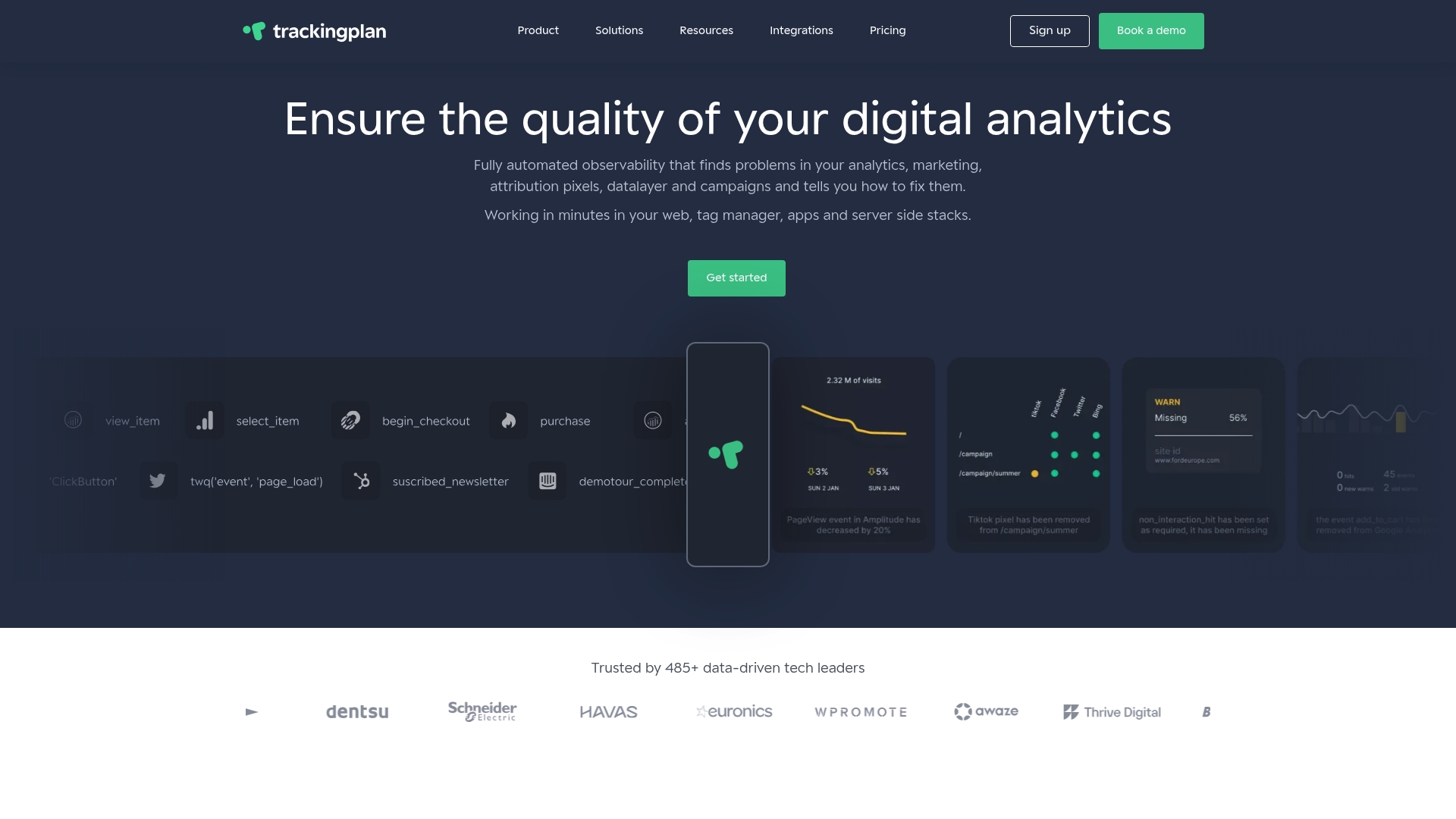
With digital analytics integration across your key platforms and automated web tracking monitoring that alerts your team via Slack, email, or Teams the moment something breaks or drifts, Trackingplan gives you the visibility you need to act before problems compound. If you are unsure whether your current tracking setup is reliable enough to support real-time decisions, start with a free analytics audit to identify gaps before they cost you.
Frequently asked questions
How does real-time monitoring boost ROI?
Real-time monitoring boosts ROI by enabling immediate campaign adjustments and dynamic budget allocation, cutting wasted spend and shifting investment to channels that are actively converting.
What is the role of AI in real-time analytics?
AI anomaly detection separates genuine data issues from normal variance, but human oversight is still essential to validate alerts and avoid over-reacting to false positives.
What marketing KPIs are most improved by real-time monitoring?
Customer retention, conversion rates, and ROAS consistently see the greatest lift, with brands reporting up to 25% higher campaign performance when real-time optimization is in place.
Is real-time monitoring expensive to implement?
Initial setup costs are real, but high initial costs are offset quickly by reduced wasted spend, faster issue resolution, and measurably improved campaign performance over time.