TL;DR:
- Accurate attribution depends on clean, complete, and unified data collection across channels.
- The choice of attribution model influences marketing budgets and campaign emphasis.
- Comparing multiple models helps identify discrepancies and improves strategic decision-making.
Most marketing teams run attribution reports every week, yet a surprising number of practitioners quietly admit they don’t fully trust the numbers. Channels get over-credited, conversions go untracked, and budget decisions rest on data that may be fundamentally flawed. Misattribution isn’t a minor inconvenience. It redirects spend toward the wrong channels, distorts ROI calculations, and erodes confidence in the entire analytics stack. This guide cuts through the noise. You’ll get a clear definition of marketing attribution, a practical breakdown of every major model, and a concrete framework for building measurement you can actually rely on.
Table of Contents
- Defining marketing attribution: What it is and why accuracy matters
- Types of marketing attribution models: From simple to sophisticated
- How attribution models impact marketing strategy and ROI
- Achieving reliable marketing attribution: Pitfalls, requirements, and next steps
- A modern perspective: Why no single attribution model tells the whole story
- Take control of your attribution with advanced tools
- Frequently asked questions
Key Takeaways
| Point | Details |
|---|---|
| Attribution defines channel credit | Properly attributing marketing impact shows you which channels actually drive conversions. |
| No model fits all | Every attribution model offers a different perspective, so use multiple for the most accurate insights. |
| Data quality is essential | Reliable attribution depends on clean, complete, and connected tracking data. |
| Comparisons reveal gaps | Reviewing results across models can uncover both over-credited and under-valued channels. |
| Frameworks drive action | Applying attribution best practices turns data into actionable ROI and smarter marketing. |
Defining marketing attribution: What it is and why accuracy matters
Marketing attribution explained is one of those topics that sounds straightforward until you try to implement it at scale. At its core, marketing attribution is the process of identifying and assigning credit to marketing touchpoints that influence customer conversions, determining which channels and interactions drive results.
That definition matters because the moment you get it wrong, every downstream decision suffers. If your model over-credits paid search and ignores the email sequence that warmed up the lead for two weeks, you’ll keep pouring budget into search while your nurture program gets cut. The business impact is real and measurable.
“Attribution isn’t just a measurement exercise. It’s the lens through which every budget decision, channel investment, and campaign optimization gets made. Blur that lens and you’re flying blind.”
Several challenges consistently undermine attribution accuracy in practice:
- Over-counting conversions when multiple platforms each claim 100% credit for the same sale
- Undercounting touchpoints because cross-device journeys break the tracking chain
- Channel silos where each platform reports independently with no unified view
- Data trust issues stemming from broken pixels, misconfigured tags, or missing UTM parameters
When you fix these problems, the payoff is significant. Accurate ad attribution enables smarter budget allocation by showing which channels genuinely move the needle. It improves ROI measurement by eliminating phantom conversions. And it builds the kind of data confidence that lets your team make bold, well-informed decisions instead of hedging every recommendation with caveats.
The foundation of good attribution is clean, complete data flowing through a unified system. Without that, even the most sophisticated model will produce misleading outputs. This is why data infrastructure deserves as much attention as model selection.
Types of marketing attribution models: From simple to sophisticated
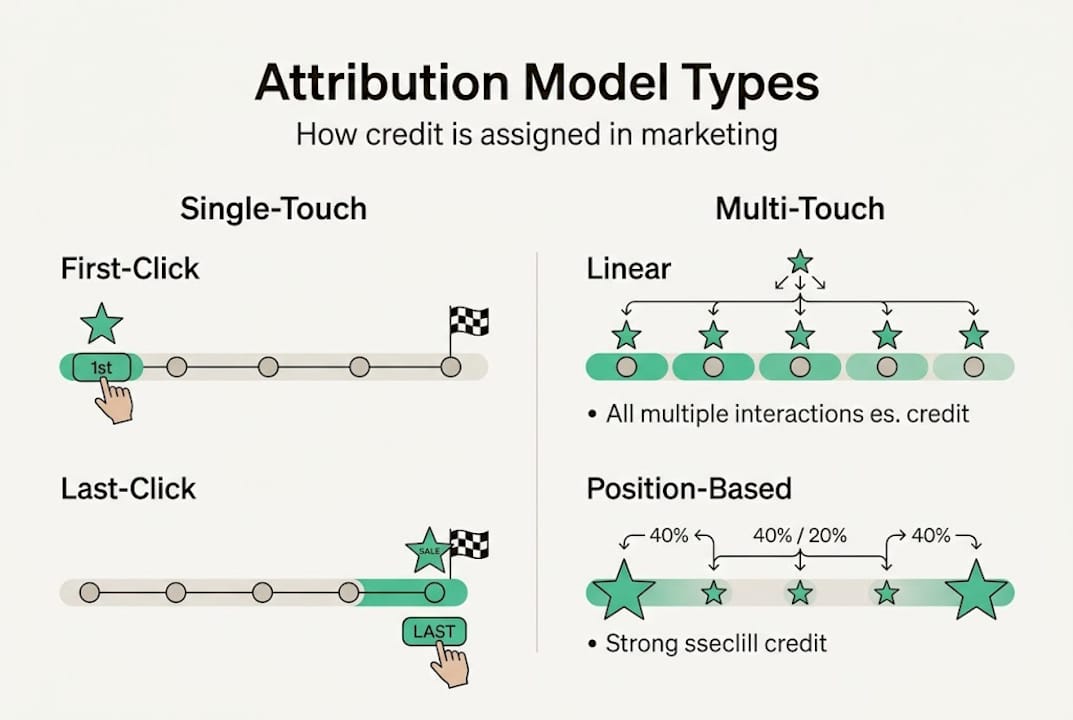
Attribution models are the rules that decide how credit gets distributed across touchpoints. Choosing the right one isn’t about finding the “best” model in the abstract. It’s about matching the model’s logic to your business reality.
Here’s a comparison of the most widely used models:
| Model | Credit distribution | Best for |
|---|---|---|
| First-click | 100% to first touch | Brand awareness campaigns |
| Last-click | 100% to final touch | Direct response, short funnels |
| Linear | Equal split across all touches | Long nurture journeys |
| Time-decay | More credit to recent touches | Short sales cycles |
| Position-based (U-shaped) | 40% first, 40% last, 20% middle | Balanced B2C funnels |
| W-shaped | Credit split at first, lead, opportunity | B2B multi-stage pipelines |
| Data-driven | ML-based on historical impact | High-volume, mature data sets |
The key methodologies break down into three families: single-touch, which assigns all credit to one interaction; multi-touch, which distributes credit across the journey using defined rules; and data-driven, which uses machine learning to weight touchpoints based on their actual historical contribution to conversions.
Here’s how to think about model selection in practice:
- Short B2C funnels with impulse purchases suit last-click or time-decay models because the final interaction is genuinely decisive.
- Long B2B sales cycles with multiple stakeholders benefit from W-shaped or data-driven models that capture the full pipeline.
- Brand-building campaigns are better evaluated with first-click, since that’s where awareness begins.
- Mature programs with large data volumes can unlock data-driven attribution, which eliminates arbitrary weighting rules entirely.
Avoid the last-touch model pitfalls that trap many teams: it systematically undervalues top-of-funnel activity and creates a feedback loop where only bottom-funnel channels get budget, starving the awareness work that feeds the entire pipeline.
Pro Tip: Run your data through both a single-touch and a multi-touch model simultaneously for one quarter. The gap between the outputs will show you exactly which channels are being misrepresented in your current reporting.
Optimizing attribution tracking starts with picking a model that matches your funnel length and data maturity, then committing to it long enough to generate actionable trends.
How attribution models impact marketing strategy and ROI
Model selection isn’t a technical detail. It directly shapes where your budget goes and which campaigns get scaled or killed. The same underlying conversion data can tell radically different stories depending on the rules you apply.

Consider this scenario: a customer discovers your product through a LinkedIn ad, engages with a retargeting display ad three days later, opens a promotional email, and then converts via a Google paid search click. Under last-click, Google Search gets 100% of the credit. Under linear attribution, each channel gets 25%. Under a position-based model, LinkedIn and Google Search each get 40%, with display and email splitting the remaining 20%.
| Channel | Last-click credit | Linear credit | Position-based credit |
|---|---|---|---|
| LinkedIn (first) | 0% | 25% | 40% |
| Display retargeting | 0% | 25% | 10% |
| 0% | 25% | 10% | |
| Google Search (last) | 100% | 25% | 40% |
Those differences translate directly into budget decisions. A team using last-click will defund LinkedIn and double down on search, potentially destroying the awareness engine that makes search conversions possible in the first place.
The most effective teams practice model triangulation. They run critical ad attribution insights across multiple models and look for discrepancies. As the research confirms, no model is perfect; comparing last-click vs. linear helps spot channels that are systematically over or under-credited.
- Compare at least two models before making major budget shifts
- Flag channels where model outputs diverge by more than 20%
- Treat those divergences as signals worth investigating, not noise to ignore
Pro Tip: Build a simple side-by-side dashboard that shows channel performance under three models at once. When a channel looks strong under all three, that’s a high-confidence signal. When it only looks good under one, dig deeper before scaling spend.
Building a digital attribution workflow that includes regular model comparisons transforms attribution from a reporting exercise into an active optimization tool.
Achieving reliable marketing attribution: Pitfalls, requirements, and next steps
Even the most thoughtfully chosen attribution model produces garbage outputs if the underlying data is broken. And broken data is far more common than most teams realize.
The most damaging pitfalls include:
- Missing tracking events because a pixel fires inconsistently or a tag was removed during a site update
- UTM parameter stripping by redirect chains, which severs the connection between ad clicks and sessions
- Cross-device fragmentation where the same user appears as multiple anonymous visitors
- Platform-level discrepancies where ad platforms, your CRM, and your analytics tool each report different conversion totals
- Siloed data that prevents a unified view of the customer journey
These common attribution data issues aren’t edge cases. They’re routine problems that compound over time, quietly distorting every report your team produces.
Building reliable attribution requires meeting minimum data standards. As attribution best practices confirm, the process of identifying and assigning credit to touchpoints only works when those touchpoints are actually being captured correctly.
Statistic to know: Studies consistently show that organizations with broken or incomplete tracking lose visibility into a significant portion of their customer journey, making any attribution model built on that data structurally unreliable.
Here’s a practical sequence for strengthening your attribution foundation:
- Audit your tracking implementation to confirm every key event fires correctly across all pages and devices
- Standardize UTM parameters with a consistent naming convention enforced across all campaigns
- Implement server-side tracking where browser-based tracking is blocked by ad blockers or privacy restrictions
- Unify your data sources into a single warehouse or analytics layer before running attribution analysis
- Schedule regular validation checks rather than waiting for anomalies to surface in reports
Addressing data quality pitfalls proactively is far less costly than diagnosing misattribution after months of budget decisions have been made on flawed data. Use attribution audit steps as a recurring process, not a one-time fix.
A modern perspective: Why no single attribution model tells the whole story
Here’s an uncomfortable truth most attribution vendors won’t tell you: the search for the perfect attribution model is a distraction. Every model is a simplification of reality. First-click ignores the close. Last-click ignores everything that built trust. Even data-driven models are constrained by the quality and completeness of the historical data they’re trained on.
The practitioners who get the most value from attribution aren’t the ones who found the right model. They’re the ones who stopped expecting any single model to be definitive. They treat attribution outputs as directional signals, not verdicts. They compare multiple models to spot discrepancies, and those discrepancies become the most interesting questions in the room.
The real discipline is staying curious. When last-click and linear disagree sharply on a channel’s contribution, that’s not a problem to resolve by picking a winner. It’s an invitation to understand the customer journey more deeply.
Invest in boosting attribution ROI by building systems that keep your underlying data clean and complete. That’s the leverage point. A mediocre model on clean data will outperform a sophisticated model on broken tracking every single time.
Take control of your attribution with advanced tools
Reliable attribution starts with reliable data, and that’s exactly where most teams hit a wall. Broken pixels, missing events, and misconfigured tags silently corrupt the foundation every attribution model depends on.
Trackingplan monitors your entire digital analytics tools stack in real time, alerting you the moment something breaks so attribution gaps don’t compound into months of bad data. The AI-assisted debugger pinpoints root causes instantly, while web tracking monitoring ensures every touchpoint is captured consistently. If you’re serious about attribution accuracy, start with the data layer. Trackingplan makes that part automatic.
Frequently asked questions
What is the difference between first-click and last-click attribution?
First-click assigns all credit to the very first touchpoint a customer interacts with, while last-click gives 100% of the credit to the final interaction before conversion. Each approach tells a very different story about which channels matter most.
When should I use multi-touch attribution over single-touch?
Use multi-touch attribution when your customer journey spans multiple channels or sessions, since multi-touch models distribute credit across all contributing touchpoints and reveal a more complete picture of influence than any single-touch approach can provide.
Why do results differ when switching attribution models?
Because each model applies different credit rules, your channel ROI shifts accordingly. Comparing last-click vs. linear is one of the fastest ways to spot channels that are being systematically over or under-valued in your current setup.
What is a data-driven attribution model?
A data-driven model uses machine learning algorithms to analyze historical conversion data and assign credit based on each touchpoint’s actual measured impact, rather than applying fixed percentage rules like other model types do.
Recommended
- Ways to optimize attribution tracking for digital accuracy | Trackingplan
- Why accurate ad attribution is critical for smarter campaigns | Trackingplan
- Mastering Adobe Marketing Attribution Your Guide to True ROI | Trackingplan
- What Is Marketing Attribution A Guide To Proving Marketing ROI | Trackingplan